
Blog
The Aggregation Rule for Charitable Donation Appraisals: Lot or Item-by-Item?
The IRS aggregation rule for charitable donation appraisals requires donors to add up similar items, not just single pieces, when checking the $5,000 qualified-appraisal threshold. This guide explains when a collection should be valued as one lot versus item-by-item, and how to avoid an invalid Form 8283.
A household full of donated furniture, a shoebox of old coins, or a shelf of first-edition books rarely gets valued the way most donors expect. The IRS does not look at each item in isolation when deciding whether a qualified appraisal is required. It looks at the group. This aggregation rule for charitable donation appraisals catches more donors off guard than almost any other part of IRS Form 8283, and getting it wrong can mean a denied deduction even when every individual item seemed too small to matter.
This matters most for executors settling an estate, donors clearing out a parent's home, or collectors giving pieces to a museum or library. If you're working through a personal property appraisal for a charitable donation, understanding how the IRS aggregates "similar items" is the difference between a clean filing and a rejected deduction.
What the Aggregation Rule Actually Requires
The aggregation rule says this: when you donate multiple items that fall into the same general category, the IRS adds their claimed values together to decide whether you've crossed the $5,000 threshold for a qualified appraisal, even if no single item comes close to that number on its own.
Treasury Regulation 1.170A-13(c)(7)(iii) and IRS Publication 561 define "similar items of property" as items of the same generic category or type. The examples the IRS gives are specific:
- Stamp collections
- Coin collections
- Lithographs and other prints
- Paintings
- Books
- Furniture
- Jewelry
If you donate 15 pieces of furniture worth $400 each, no single piece triggers anything on its own. But $400 times 15 is $6,000, and because furniture is a single category under the rule, that full amount counts against the $5,000 line. The same math applies to a coin collection split across several denominations, or a set of paintings given over the course of a single tax year.
Key takeaway: The threshold question isn't "is this item worth more than $5,000?" It's "is the total claimed deduction for everything in this category worth more than $5,000?"
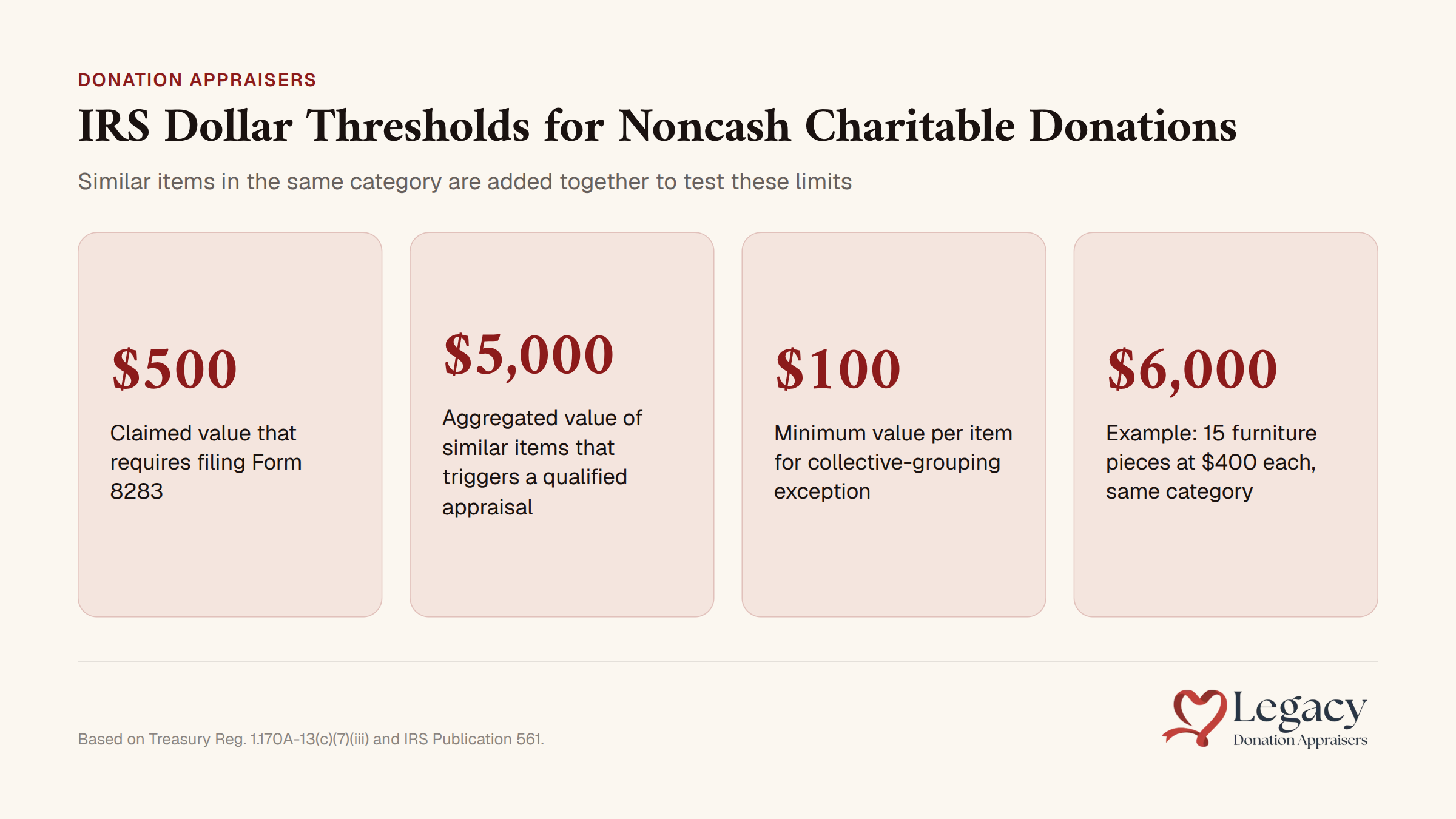
How the $5,000 Threshold Is Calculated Across Similar Items
The calculation is cumulative across the entire tax year, not per donation event. If you give books to a library in March and more books to a different library in October, both donations count toward the same category total for that year.
Example: A donor gives a coin collection to a historical society in February, claiming $2,200. In September, the same donor gives additional coins from a different set to a university library, claiming $3,100. Individually, neither donation looks close to $5,000. Added together, the coin donations total $5,300, which crosses the threshold and requires a qualified appraisal for the group.
The rule applies even when the items go to different organizations. IRS Publication 526 confirms that a separate Form 8283 is still required for each donee organization, but the aggregate claimed deduction across all donees is what determines whether the appraisal requirement kicks in at all. A donor cannot avoid the appraisal requirement by spreading similar items across multiple charities in the same year.
A related, lower threshold also applies. Form 8283 itself is required once total noncash contributions for the year exceed $500, regardless of whether any single category reaches $5,000. The $500 and $5,000 thresholds operate independently, and donors sometimes satisfy one while missing the other. Our FAQ on the threshold for Form 8283 walks through how the two interact in more detail.
Single Lot or Itemized: Collection vs Assemblage
Once a group of similar items crosses the $5,000 threshold, the next decision is how to value it: as one integrated lot, or item-by-item within the category. This is where appraisers draw a real distinction, and it isn't just a formatting choice.
A true collection is the product of deliberate selection, connoisseurship, and often decades of focused acquisition. A curated set of early American coins assembled by a knowledgeable collector, or a cohesive run of first-edition books by a single author, can be worth more as an intact whole than the sum of its individual pieces, because completeness and provenance add value that doesn't exist in any single item. Occasionally the opposite is true: a collection sold piece by piece to different specialist buyers nets more than a single buyer would pay for the whole. Either way, a collection can legitimately be valued as one integrated property.
An assemblage is different. This is simply a grouping of household goods, furniture, or similar items that happen to share a category but were not acquired with any unifying intent. A household's worth of furniture accumulated over 20 years of ordinary living is an assemblage, not a collection. These are generally valued item-by-item within the category, even though they still get reported and aggregated together for the $5,000 threshold calculation.
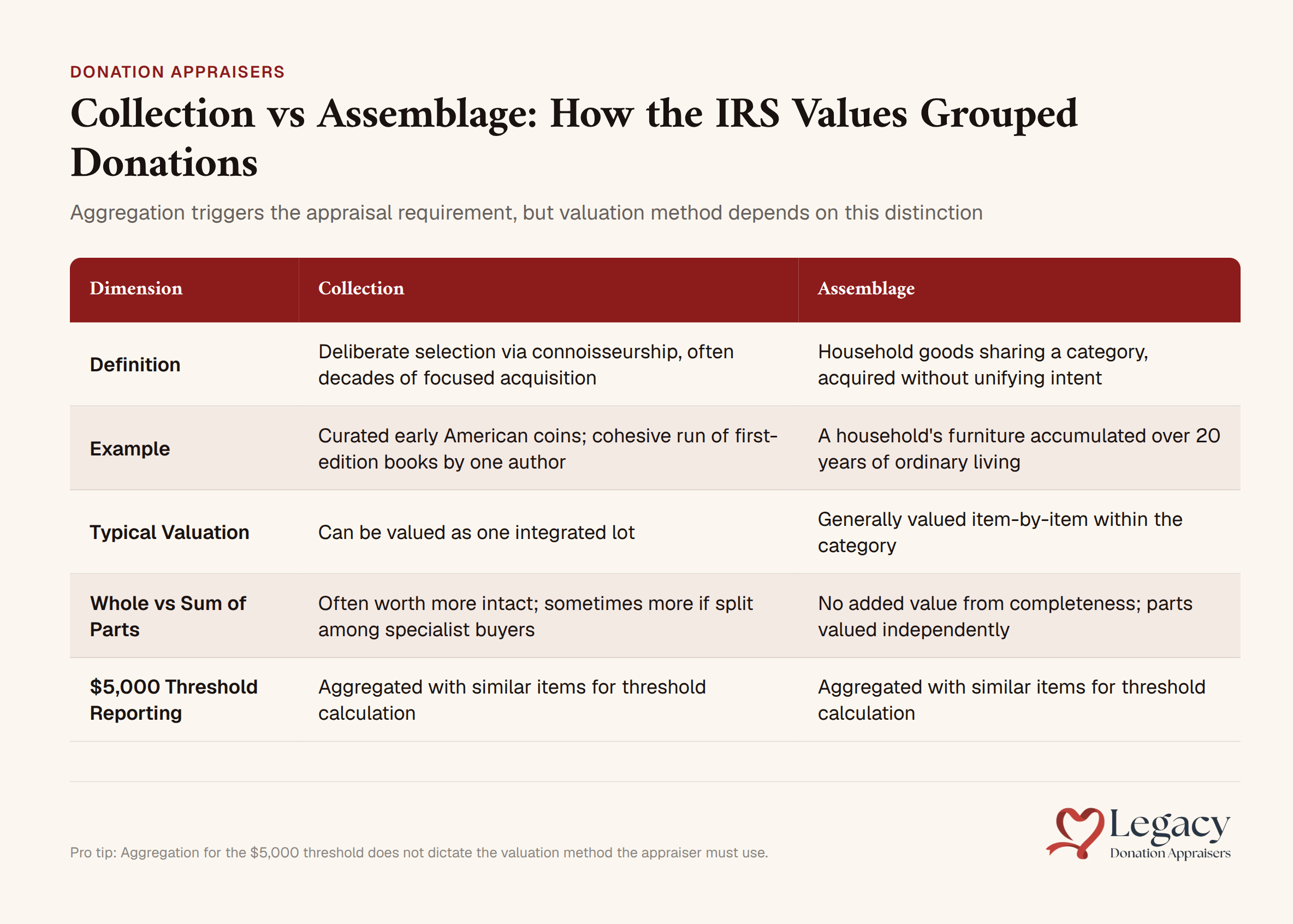
Pro tip: Don't assume a group of similar items must be valued as a single lot just because the IRS aggregates them for threshold purposes. Aggregation determines whether an appraisal is required. It does not dictate the valuation method the appraiser uses once that requirement is triggered.
One Appraisal, Multiple Items: What the Report Must Include
Here's the practical relief in the rule: the IRS does not require a separate appraisal for every single item in a group of similar property. The instructions to Form 8283 are explicit that only one qualified appraisal is needed for a group of similar items contributed in the same tax year, as long as the report includes all the information the IRS requires for each item in the group.
That means a single appraisal report can cover an entire coin collection, furniture set, or run of artwork, provided it:
- Describes each item (or sub-group) with enough specificity to identify it
- States the fair market value conclusion for each item or sub-group
- Documents the valuation method and the comparable sales or data relied on
- Is signed by a qualified appraiser who meets the IRS's qualification standards
There's one narrow exception that simplifies things further. The appraiser may group similar items with a collective value of $100 or less without itemizing each piece individually within that small group. A box of inexpensive paperbacks or costume jewelry pieces that collectively appraise at $100 or less can be described and valued as a lump sum rather than piece by piece.
Dissimilar items, on the other hand, cannot be blended together this way. A donation that includes furniture, jewelry, and books requires separate treatment for each category on Form 8283, though all three can still live inside one appraisal report as long as each category gets its own clearly separated section. Our guidance on what is the IRS Form 8283 used for covers how the sections and categories are organized on the form itself.
Multiple Donees Complicate the Form, Not the Math
Donors often assume that giving to several charities resets the threshold calculation. It doesn't. The aggregation math for similar items stays constant across donees; only the paperwork splits.
If a donor gives similar items to more than one organization and the combined claimed deduction exceeds $5,000, a separate Form 8283 is required for each donee, but every form still reflects a share of the same qualified appraisal covering the full group. Skipping the appraisal because each individual donee received less than $5,000 worth of property is one of the more common filing mistakes, and it's an easy one for the IRS to catch on review.
Watch out: Splitting a donation across two charities to keep each gift under $5,000 does not avoid the appraisal requirement. The IRS aggregates by category across the full tax year, not by recipient.
Getting the Aggregation Math Wrong Risks the Whole Deduction
An incorrect aggregation calculation doesn't just create a paperwork problem. If a donor claims a deduction for a group of similar items exceeding $5,000 without the required qualified appraisal and properly completed Section B of Form 8283, the IRS can disallow the entire deduction for that group, not just the portion above the threshold.
This is why estate executors and household donors benefit from having an appraiser look at the full scope of what's being donated before anything leaves the house. An appraiser who understands the aggregation rule can flag, before the donation is finalized, whether a set of items needs to be treated as one qualified-appraisal group, whether a true collection premium applies, and how the report should be structured to survive IRS review. Appraisers working in this space typically hold credentials through organizations such as the ISA, ASA, or AAA, and prepare reports consistent with recognized appraisal standards.
For donors managing a sizable estate or household clearance, it's worth scoping the appraisal before donating rather than after. Our team can review the full list of items being given, group them correctly under the aggregation rule, and prepare a single qualified appraisal report that covers the entire similar-items category for the tax year. You can request an appraisal once you have a rough inventory of what's being donated and to which organizations.
This article is provided for general informational purposes only and does not constitute legal, tax, or financial advice. Readers should consult a qualified attorney or CPA regarding their specific circumstances.