
Blog
What to Do When a Charity Won't Sign Form 8283 and Your Deduction Is at Stake
When a charity won't sign Form 8283, the donor has specific steps that can still keep the deduction on track. This walkthrough covers why charities hesitate, how to persuade them, and what the IRS instructions say to attach if the signature is truly impossible to get.
Published
Key Takeaways on a Charity That Won't Sign Form 8283
Here is what donors need to know when a charity won't sign Form 8283:
- Who signs: Part V of Form 8283 Section B must be signed by an official authorized to sign the charity's tax or information returns, or by a person that official specifically designates. A volunteer or front-desk employee without that authority cannot complete it.
- What the signature means: The donee's signature acknowledges receipt of the property and the charity's Form 8282 reporting duty. Under Treas. Reg. 1.170A-16(f), the signature does not represent agreement with the appraised value.
- If the signature is impossible: The donor attaches a detailed written explanation to the return, and the IRS instructions say the deduction is not disallowed solely for that reason. A preference not to ask does not count as impossibility.
- Separate requirements remain: The charity's written acknowledgment for gifts of $250 or more and the qualified appraisal for gifts over $5,000 are independent of the Part V signature. Our IRS Form 8283 guide covers the form line by line.
A charity that won't sign Form 8283 puts a donor in an uncomfortable spot, because the form is due with the tax return and the deduction depends on it. The refusal usually comes from a misunderstanding of what the signature means, and it is often fixable. This guide explains Part V, why charities hesitate, how to ask effectively, and what to attach when the signature cannot be obtained.
What Part V of Form 8283 Section B Requires
Part V of Form 8283 Section B is the donee acknowledgment, and it must be signed by the charity. The Form 8283 instructions specify that the signer is an official authorized to sign the donee's tax or information returns, or a person that official specifically designates. In practice that means a development director, chief financial officer, treasurer, or executive director.
Section B applies when the claimed deduction exceeds $5,000 for a single item or a group of similar items. Each donee needs its own Form 8283 Section B, so a donor who gives to 2 charities completes 2 separate forms.
Form 8283 is an appraisal summary, not an appraisal. The qualified appraisal is a separate document prepared by a qualified appraiser, and the form summarizes it. Our appraisers sign Part IV, the appraiser declaration, as qualified appraisers, and the donor completes Parts I through III before sending the form to the charity for Part V.
What the Charity's Signature Does and Does Not Mean
The donee's signature on Form 8283 confirms 2 facts: the charity received the property, and the charity understands its reporting obligation if it sells or otherwise disposes of the property. If the charity disposes of the item within 3 years of the contribution, it must file Form 8282 with the IRS within 125 days of the disposition and send a copy to the donor. The IRS explains that duty on its Form 8282 page.
The signature does not say the charity agrees with the appraised value. Treas. Reg. 1.170A-16(f) states that the donee's signature does not represent concurrence in the appraised value.
This point is the strongest reassurance a donor can give a hesitant charity. The charity is acknowledging receipt, not endorsing a number.
Watch out: A charity that signs Part V is not vouching for the donor's deduction. The donor's value comes from the qualified appraisal, and the IRS evaluates that value independently.
Why a Charity Won't Sign Form 8283
Charities decline for predictable reasons, and most involve art, vehicles, equipment, or collectibles where values are large and the form is unfamiliar. Common reasons include the following:
- Fear of endorsing the value: Staff assume the signature confirms the appraised amount, which it does not.
- Form 8282 tracking burden: Small organizations worry about monitoring each item for 3 years and filing within 125 days if they sell it.
- Reluctance to commit to keeping the item: The charity plans to sell the donated property quickly and does not want a reporting obligation attached.
- Unfamiliarity with the form: Many nonprofits receive few gifts that need Section B, so staff have never completed Part V.
- Authority problems: The person who received the gift is not an official authorized to sign the charity's returns, and nobody has designated a signer.
Each reason has a practical answer, which is why the first step is a conversation rather than a workaround.
How a Donor Gets a Charity to Sign Form 8283
A donor improves the odds of a signature by preparing the request before the gift is made. The following sequence works for most donations:
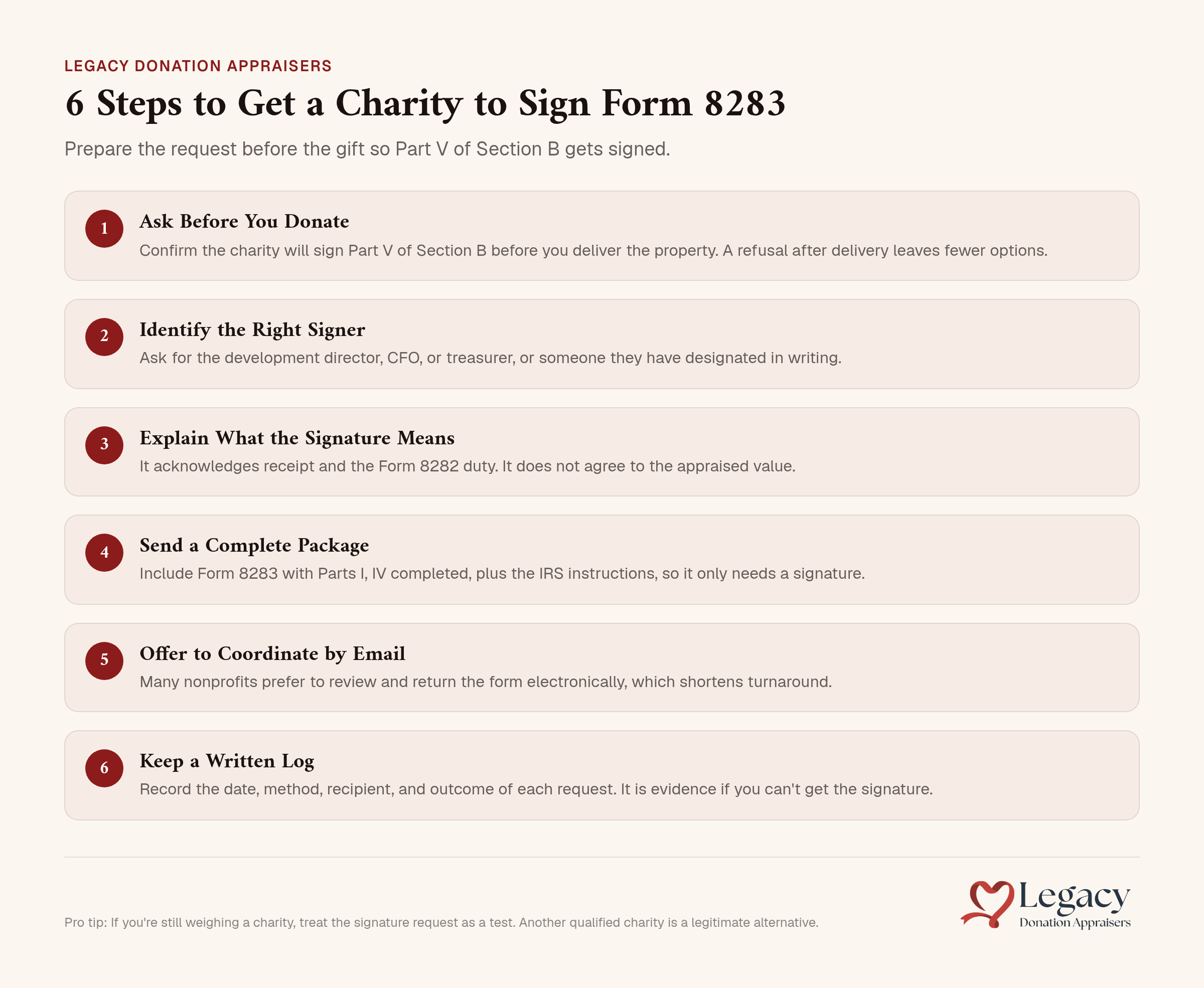
- Ask Before You Donate
- Confirm that the charity will sign Part V of Form 8283 Section B before delivering the property. Lead time matters, because a refusal after delivery leaves fewer options.
- Identify the Right Signer
- Ask for the development director, CFO, or treasurer, or for the person that official has designated in writing. The signature is valid only from someone with that authority.
- Explain What the Signature Means
- State plainly that the signature acknowledges receipt and the Form 8282 duty, and that it does not agree to the appraised value.
- Send a Complete Package
- Provide Form 8283 with Parts I through IV completed, plus the IRS instructions for the form. A form that needs only a signature gets signed faster than one that needs explanation.
- Offer to Coordinate by Email
- Many nonprofits prefer to review and return the form electronically, which shortens the turnaround.
- Keep a Written Log
- Record the date, method, recipient, and outcome of every request. The log becomes evidence if the signature cannot be obtained.
Pro tip: A donor who is still weighing a charity can treat the signature request as a test. A charity that will not acknowledge a significant gift on a standard IRS form is a poor partner, and a different qualified charity is a legitimate alternative.
Form 8283 Options When the Signature Is Truly Impossible
The Form 8283 instructions provide a fallback when the donee's signature cannot be obtained. The donor attaches a detailed explanation of why obtaining the signature was impossible, and the deduction is not disallowed solely because the signature is missing. The IRS instructions on Form 8283 describe this exception.
The standard is impossibility, not inconvenience. A charity that has dissolved, a signer who cannot be located after documented efforts, or a charity that refuses in writing after repeated requests can support the exception. A donor who simply preferred not to ask cannot.
A strong explanation includes the following details:
- When and how the donor requested the signature, and whom the donor contacted
- Whether the contact held authority to sign the charity's returns
- The charity's stated reason for refusing, ideally in writing
- Dates of follow-up attempts
- Evidence that the charity received the property, such as delivery records or emails
The donor attaches Form 8283 to the return with all required signatures that could be obtained. The instructions also bar a notation such as "available upon request" in place of required information, so the explanation must be on or with the filed return.
A deduction without the required Section B completion is generally disallowed unless the failure was due to reasonable cause and not willful neglect. IRS Publication 561 states that standard for Form 8283 failures.
How an Unsigned Form 8283 Affects Other Substantiation
The Part V signature is only one piece of the substantiation file. A charity's refusal to sign does not remove the other requirements, and a signature does not satisfy them. Each requirement stands on its own, as the following table shows:
| Requirement | Trigger | What it involves |
|---|---|---|
| Contemporaneous written acknowledgment | Gift of $250 or more | Charity letter describing the property and stating whether goods or services were provided |
| Form 8283 Section A | Noncash gifts over $500 up to $5,000 per item or group | Donor completes the form without an appraisal summary |
| Form 8283 Section B and qualified appraisal | Deduction over $5,000 per item or group of similar items | Appraisal summary with Part IV appraiser declaration and Part V donee acknowledgment |
| Appraisal attached to return | Deduction over $500,000 | Full qualified appraisal included with the return |
IRS Publication 526 lays out these thresholds, and IRS Topic 506 summarizes the written acknowledgment rule. A Part V signature never substitutes for the acknowledgment letter, so a donor should request both at the same time. Our comparison of the written acknowledgment and the qualified appraisal shows how the 2 documents differ.
Vehicle Donations and Form 1098-C
Vehicles follow a different path. For a qualified vehicle with a claimed value over $500, the donor must attach the charity's Form 1098-C or other written acknowledgment to the return. When the deduction is limited to the gross proceeds from the charity's sale of the vehicle, the instructions generally route the gift to Section A rather than Section B.
Protecting Your Charitable Deduction Before You Donate
A charity won't sign Form 8283 most often because nobody explained the form in advance. Early communication, a complete package, and the right signer resolve the majority of refusals. Documentation of every attempt protects the donor if the signature still cannot be obtained.
Legacy Donation Appraisers prepares qualified appraisals for noncash gifts in accordance with IRS requirements and USPAP, and our appraisers complete Part IV of Form 8283 Section B. Our appraisers hold credentials with leading organizations such as the ASA, ISA, and AAA. Donors who want an appraisal ready before they approach a charity can request an appraisal and start the signature conversation with a finished package.
This article is provided for general informational purposes only and does not constitute legal, tax, or financial advice. Readers should consult a qualified attorney or CPA regarding their specific circumstances.