
Blog
Clothing and Apparel Inventory Appraisal Guide for Charitable Donations
Donating clothing or an apparel inventory lot triggers different IRS rules depending on condition and value. This guide walks through the $500 and $5,000 thresholds, the three fair market value methods in IRS Publication 561, and why bulk apparel lots need a category-based appraisal instead of item-by-item pricing.
Clothing donations are some of the most common noncash gifts reported on tax returns, and also some of the most misunderstood. A single bag of used clothes usually needs nothing more than a receipt. A closet-clearing estate donation, a boutique inventory liquidation, or a vintage costume collection is a different animal entirely, and treating it like a bag of clothes is how donors lose deductions or draw IRS scrutiny. This guide covers the condition rule, the dollar thresholds that trigger a qualified appraisal, and how an inventory appraisal service approaches bulk apparel lots.
The "Good Used Condition or Better" Rule
The IRS will not allow a deduction for clothing unless it is in good used condition or better, with one narrow exception covered below. IRS Publication 561 states plainly that used clothing and other personal items are usually worth far less than what the donor originally paid, and that valuation "does not lend itself to fixed formulas or methods."
Instead, the IRS points donors toward actual resale markets. The price that buyers pay for similar items at consignment shops or thrift stores is treated as evidence of fair market value. That means:
- A donor cannot claim the original retail price of a garment, even if it was barely worn.
- A donor cannot apply a flat percentage discount (such as "half of what I paid") as a substitute for real market data.
- Generic valuation charts that assign a fixed dollar figure per category of clothing are not an acceptable substitute for actual comparable pricing, a point The Tax Adviser has also flagged as a common taxpayer mistake.
Key takeaway: unless you can point to what similar used items actually sell for in a secondary market, you don't have a defensible fair market value, no matter how confident the number feels.
The $500 Exception for Items Not in Good Condition
There is one situation where clothing that fails the good-condition standard can still be deducted: when a single item is not in good used condition or better, but the claimed deduction for that item exceeds $500. In that case, IRS Publication 561 and Publication 526 both require a qualified appraisal and a completed Form 8283 attached to the return.
This exception matters more than it sounds. A vintage designer gown with visible wear, a damaged fur coat with strong material value, or a costume piece from a notable production can still carry real value despite condition issues that would sink an ordinary garment. Without a qualified appraisal in hand, that deduction is not allowed at all.
The $5,000 Threshold and Form 8283 Section B
For most noncash property, including clothing, a claimed deduction of more than $5,000 for an item or group of similar items requires a qualified appraisal signed and dated by a qualified appraiser, along with a completed Form 8283. The Form 8283 instructions split the form into two sections based on value:
- Section A covers items or groups of similar items with a combined claimed value between $501 and $5,000.
- Section B covers items or groups of similar items with a combined claimed value over $5,000, and generally requires a signed qualified appraisal summary attached to the return.
"Similar items" is the key phrase here. The IRS aggregates clothing donations of the same general type made during the year, not just what's on a single receipt. A donor who gives three separate bags of clothing to three different charities in the same year, each worth $2,000, has made a $6,000 donation of similar items for threshold purposes and needs to plan accordingly. IRS Topic No. 506 confirms this aggregation approach applies broadly to noncash contributions.
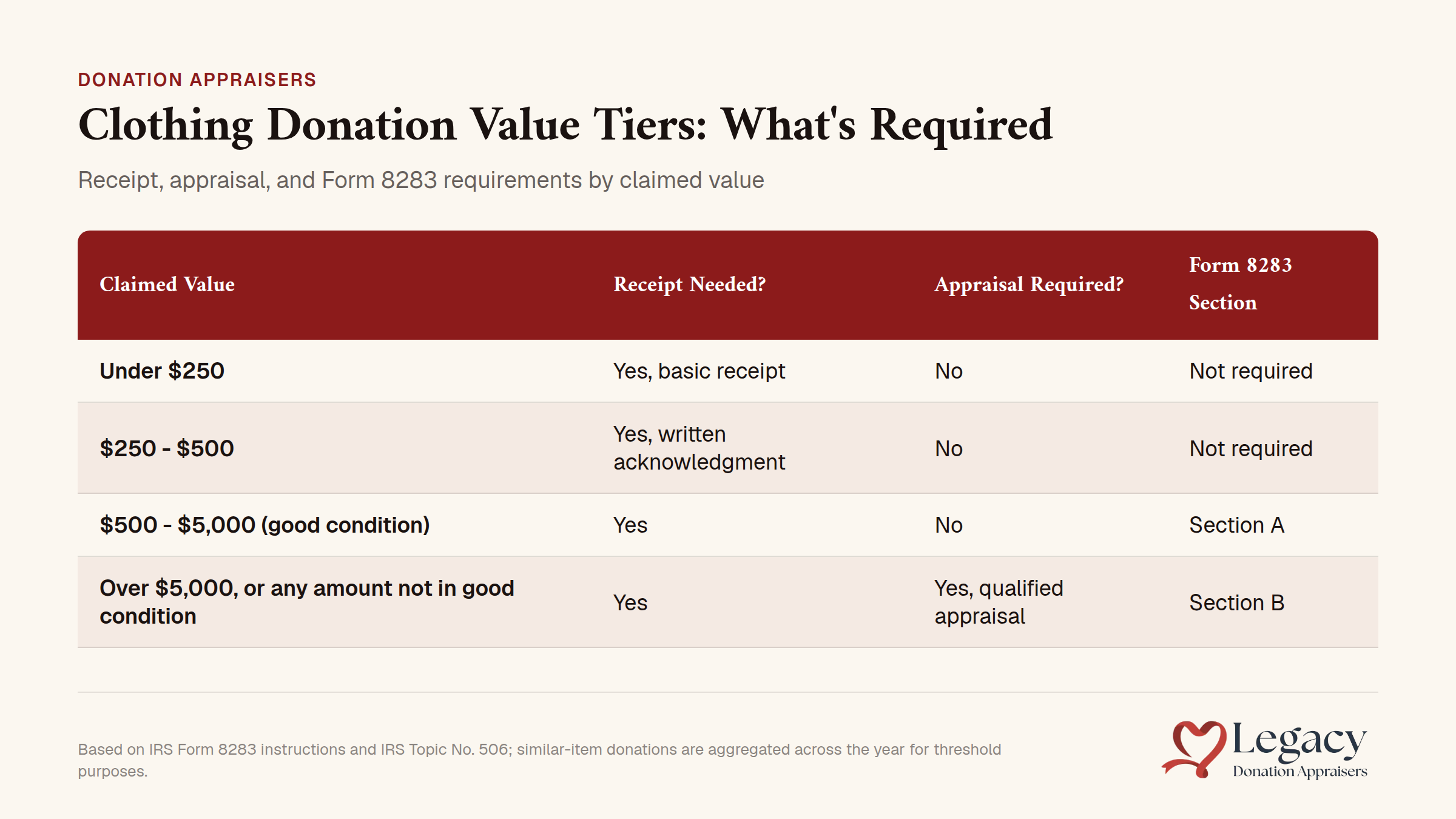
| Claimed Value | Receipt Needed? | Appraisal Required? | Form 8283 |
|---|---|---|---|
| Under $250 | Yes, basic receipt | No | Not required |
| $250 - $500 | Yes, contemporaneous written acknowledgment | No | Not required |
| $500 - $5,000 (good condition) | Yes | No | Section A |
| Any amount, item not in good used condition | Yes | Yes, qualified appraisal | Section B |
| Over $5,000 (any condition) | Yes | Yes, qualified appraisal | Section B |
Why Bulk Apparel Lots Need Category-Based Appraisal
Estate executors, family members closing out a relative's wardrobe, and small boutique owners winding down inventory all run into the same problem: hundreds or thousands of individual garments, and no realistic way to price each one separately. This is where the appraisal approach for a large apparel lot diverges sharply from a single bag of clothes.
Common scenarios that call for a full apparel inventory appraisal rather than a simple receipt include:
- Estate closets, where a deceased individual's wardrobe includes decades of clothing, some designer, some ordinary, donated in bulk to a single charity.
- Boutique or retail liquidations, where a business closes and donates remaining apparel inventory instead of discounting or discarding it.
- Costume and vintage collections, where garments carry historical or collectible value well beyond what a thrift-store comparison alone would suggest.
Pricing 800 individual t-shirts, dresses, and jackets one by one is neither practical nor how the IRS methodology actually works. Publication 561 recognizes three general approaches to fair market value: comparable sales, replacement cost adjusted for age and condition, and, where relevant, cost or selling price of the property itself. For a large apparel lot, our approach applies these methods at the category level instead of the item level.
How We Approach Large Apparel Donation Lots
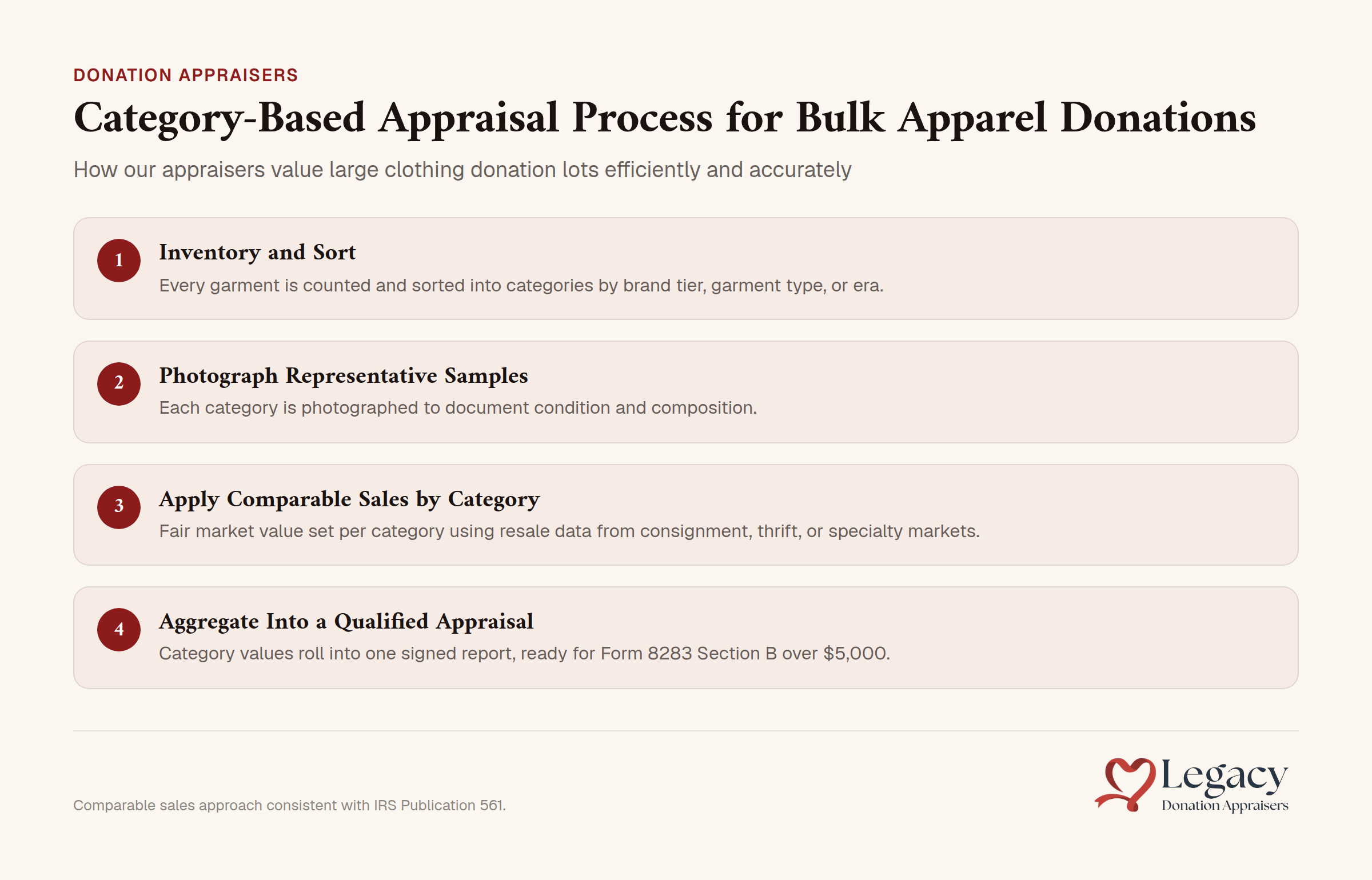
Our appraisers group bulk apparel donations into representative categories before applying any valuation method. A single lot might be broken into categories such as designer outerwear, mid-range everyday wear, costume or vintage pieces, and accessories, with each category priced against comparable sales for that tier of merchandise. Photographs document the general condition and composition of each category so the report stands on its own if questioned later.
- Inventory and Sort
- Every garment is counted and sorted into logical categories, typically by brand tier, garment type, or era rather than by individual SKU.
- Photograph Representative Samples
- Each category is photographed to document condition and composition, giving the report visual support without requiring a photo of every single item.
- Apply Comparable Sales by Category
- Fair market value is established for each category using actual resale data from consignment shops, thrift retailers, or specialty markets, consistent with the comparable sales method described in Publication 561.
- Aggregate Into a Qualified Appraisal
- Category values roll up into a single report with a signed appraisal summary, ready to attach to Form 8283 Section B when the total exceeds $5,000.
This category-based method keeps the appraisal grounded in real market data while making a 500-garment estate donation or boutique liquidation actually feasible to value on a reasonable timeline and budget.
What a Clothing Appraisal Costs
For clothing appraisals, fees are quoted as a fixed fee before work begins. A standard clothing appraisal for a smaller lot starts at $195, and an advanced, IRS-qualified appraisal suitable for attachment to Form 8283 Section B starts at $295. Typical engagements for moderate-sized donations run $395 to $2,200, while large estate wardrobes, boutique inventory liquidations, or notable costume collections can run $1,600 to $3,500 or more depending on the number of items, the number of categories, and the depth of comparable-sales research required.
These fees are driven by the scope of the assignment, meaning how many garments, how many distinct categories, and how much documentation the intended use requires, never by the dollar value of the clothing itself. An engagement is always quoted as a fixed fee once the assignment is scoped, not billed by the hour.
Documenting the Donation Correctly
Whatever the size of the donation, the paperwork matters as much as the valuation itself. Beyond the appraisal report, donors should keep:
- A contemporaneous written acknowledgment from the receiving charity, describing the items donated and confirming no goods or services were received in exchange.
- A completed Form 8283, with Section A or Section B filled out depending on the aggregate claimed value.
- Photographs and category descriptions supporting the condition and composition of the donated lot, especially for bulk apparel donations.
- The signed qualified appraisal, when the claimed deduction requires one, kept with tax records even when the summary itself is attached to the return.
Donors who are unsure whether their situation crosses the $5,000 line, or whether a specific damaged item qualifies for the good-condition exception, can review the general threshold rules for Form 8283 before filing.
Getting the Valuation Right the First Time
A single bag of clothing rarely needs more than a receipt. But once a donation involves a damaged high-value item, crosses $5,000 in aggregate value, or consists of a large apparel inventory lot, the IRS expects a qualified appraisal built on real comparable sales, not guesswork or a flat percentage of retail. Getting the categories, the comparables, and the documentation right the first time is what keeps a deduction standing up if it's ever reviewed. Our appraisers prepare USPAP-compliant clothing and apparel inventory appraisals sized to the donation, from a single vintage piece to a full estate wardrobe, so the report matches exactly what the IRS requires for the value you're claiming.
This article is provided for general informational purposes only and does not constitute legal, tax, or financial advice. Readers should consult a qualified attorney or CPA regarding their specific circumstances.