
Blog
Comparable Sales Method for Charitable Donation Appraisals: How Recent and Similar Must They Be
The comparable sales method drives most charitable donation appraisals, but a comp only counts if it's recent enough and similar enough to your item. This guide explains the IRS weighting factors, the 60-day appraisal window, and how to spot a comparable sale that won't hold up under review.
When you donate a painting, a coin collection, or a set of antique furniture and claim a deduction over $5,000, your appraiser almost always leans on comparable sales to justify the value. The method sounds simple: find what similar items sold for, then use those prices to support your number. In practice, the IRS scrutinizes exactly how similar and how recent those sales are, and a weak comparable can quietly undermine an otherwise solid personal property appraisal.
What Is the Comparable Sales Method in a Donation Appraisal?
The comparable sales method values a donated item by analyzing what similar items actually sold for in the relevant market, then adjusting those prices for differences between the comparable item and the donated one. It's the approach appraisers rely on most often because it's grounded in real transactions rather than opinion.
Credentialed appraisers, including those holding designations from organizations such as the ISA, ASA, and AAA, are trained to build this analysis carefully because it's the section of a report the IRS reviews most closely. A well-supported comparable sales analysis shows your appraiser's math, not just a conclusion pulled from a price guide.
The Weighting Factors Behind Every Comparable Sale
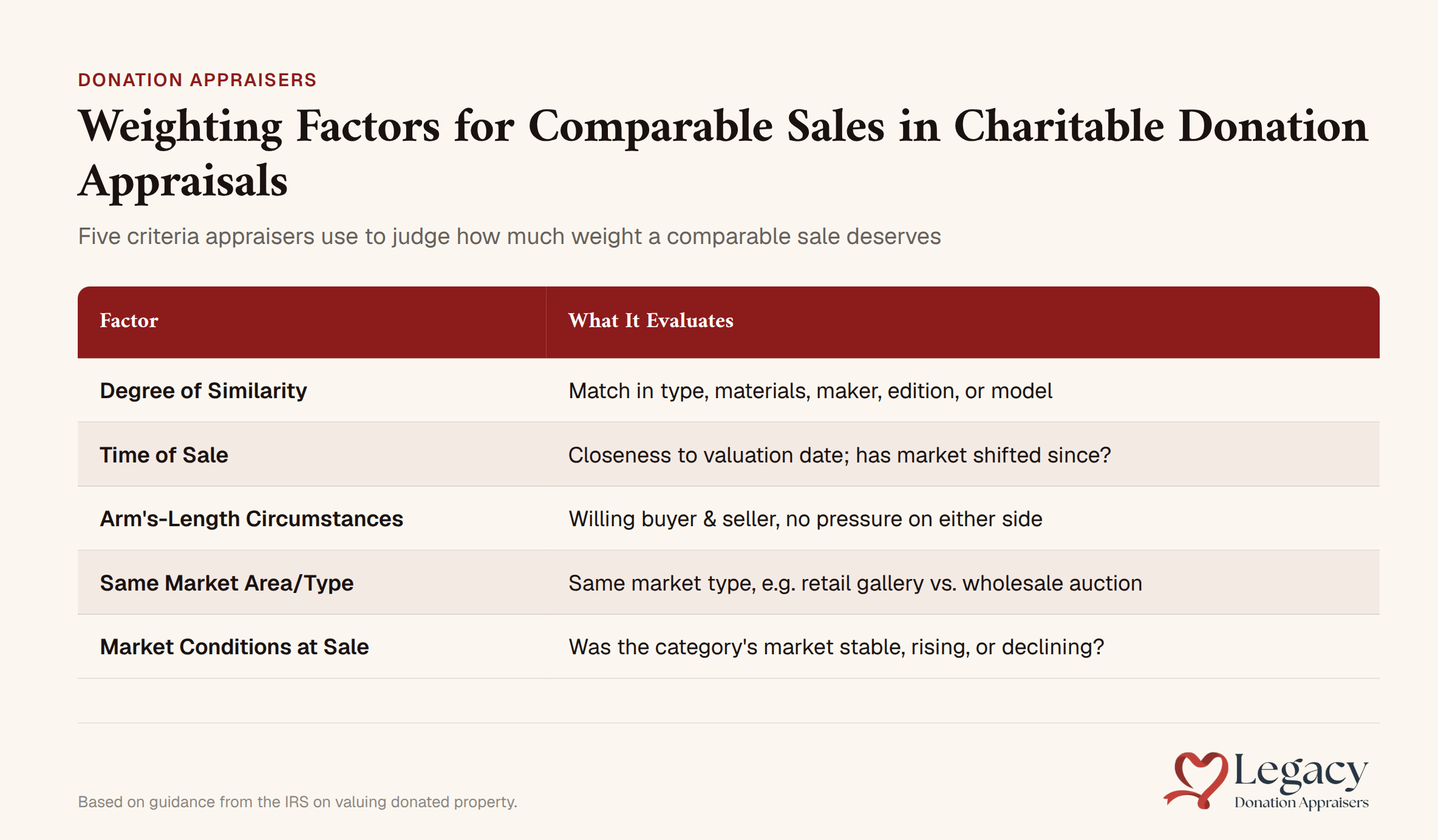
Not every comparable sale deserves equal weight in a valuation. Appraisers evaluate each comp against a set of factors before deciding how much it should influence the final number, and guidance from the IRS points to several that matter most:
- Degree of similarity: How closely does the comparable item match the donated item in type, materials, maker, edition, or model?
- Time of sale relative to the valuation date: Was the comparable sale close in time to the date of the donation, or from a market that has since shifted?
- Arm's-length circumstances: Did the sale happen between a willing buyer and willing seller, with neither party under pressure to buy or sell?
- Same market area or type of market: Did the comparable sale occur in the same market where the donated item would typically change hands, such as a retail gallery versus a wholesale auction?
- Market conditions at the time of sale: Was the broader market for that category of item stable, rising, or declining when the comparable sale took place?
A comp that scores well on similarity but poorly on timing, or vice versa, gets less weight in the final analysis. Appraisers weigh all five factors together rather than leaning on just one.
How Recent Do Comparable Sales Need to Be?
Comparable sales should be as close as possible to the date of donation, and the appraisal report itself carries its own recency rule. For a charitable donation, the appraisal generally must be dated no earlier than 60 days before the date of contribution, which keeps the valuation tied to market conditions that actually existed when you gave the item away.
That 60-day window applies to the appraisal date, not necessarily to every comparable sale inside it. An appraiser can reach further back for comps in a stable, slow-moving market (heavy machinery, for example) than in a volatile one (contemporary art, cryptocurrency, or collectible coins tied to spot metal prices). The further back a comp sits, the more the report needs to show that the market hasn't shifted meaningfully in the interim.
Once your donation clears the $5,000 threshold that triggers a qualified appraisal, this timing detail stops being a technicality. An outdated comp is one of the easiest things for a reviewer to flag.
Selecting Comparable Sales: When a Close Price Isn't a Close Match
A sale price that looks similar on paper can still be the wrong comparable. A classic illustration involves a rare book: a $300 sale of what appeared to be the same title turned out to be a different edition in noticeably worse condition than the donated copy. Because the edition and condition didn't match, that $300 sale carried little weight in establishing fair market value, no matter how tempting it was to cite as a quick benchmark.
The lesson generalizes across asset types. Two oil paintings by the same artist can differ enormously in value based on size, subject matter, and provenance. Two vintage watches with the same model number can differ based on original box and papers, movement condition, and whether parts have been replaced. Appraisers select comps by matching the specific attributes that drive value in that category, not just the broad category itself.
Watch out: A donor who hands an appraiser a single "similar" auction result and expects it to substantiate the whole valuation is setting the report up to fail. One weak comp rarely survives scrutiny on its own.
Condition Adjustments and Paired-Sales Adjustment Logic
Once an appraiser identifies genuinely comparable sales, the next step is adjusting each one for the differences that remain. This is standard industry practice, often described as paired-sales analysis: comparing two similar transactions that differ in one identifiable way, then isolating the dollar or percentage impact of that difference.
Example: Suppose two nearly identical mid-century chairs sold at auction within the same year. One in excellent original condition sold for $1,200, and one with a reupholstered seat and a repaired arm sold for $850. That $350 gap gives the appraiser a documented basis for adjusting other comparable sales up or down based on condition, rather than guessing at a percentage.
Appraisers document each adjustment they make and explain why it was necessary. Only the comparable sales requiring the fewest and smallest adjustments should carry the most weight in the final conclusion; a comp that needs five separate adjustments to line up with the donated item is inherently less reliable than one that needs none.
Why a Weak Comparable Cannot Survive an IRS Review
A donation appraisal is only as strong as the facts behind it. The IRS gives less weight to an appraiser's opinion when it isn't backed by verifiable evidence such as comparable sales, and reviewers have historically rejected appraisals that rely mainly on an appraiser's personal judgment rather than documented transactions.
For each comparable sale cited, a defensible report typically documents the sale date and price, a description of the item sold, the venue or market where it sold, and the specific adjustments made to account for differences from the donated property. Missing any of that documentation makes it harder to defend the value if the IRS asks questions later, and it's exactly the kind of gap that turns a routine Form 8283 filing into a drawn-out back-and-forth.
Key takeaway: A comparable sale that's recent, similar, arm's-length, from the right market, and properly adjusted does more to protect your deduction than any single dramatic sale price ever could.
Questions to Ask Before You Hire a Donation Appraiser
Before you commit to an appraiser, it helps to know how they'll handle this part of the work. Ask the following before you sign off:
- How many comparable sales will you cite, and from what market or venue?
- How will you document the adjustments you make between each comp and my item?
- How recent are the comparable sales you plan to use, and why?
- Can you explain how your final value would hold up if the IRS asked you to defend it?
An appraiser who meets the IRS qualified appraiser requirements should be able to answer all four questions specifically, not in general terms. If the answers feel vague, that's a sign to keep looking.
Building a Report That Holds Up
A comparable sales analysis is the backbone of most donation appraisals, and it's also the part most likely to draw a second look if your deduction is ever questioned. Choosing an appraiser who documents recency, similarity, and adjustments carefully from the start saves you from having to defend a thin report months or years later. We prepare valuations built on exactly this kind of documented comparable sales analysis for donors across personal property categories, and we'd be glad to walk through your donation and scope the work as a fixed fee before anything begins.
This article is provided for general informational purposes only and does not constitute legal, tax, or financial advice. Readers should consult a qualified attorney or CPA regarding their specific circumstances.