
Blog
Contemporaneous Written Acknowledgment vs Qualified Appraisal: What Each Document Proves
The charitable contribution written acknowledgment requirement and the qualified appraisal requirement are separate IRS rules that prove different things, and for many noncash gifts over $5,000, you need both. This guide breaks down what each document actually substantiates.
Donors who give a valuable painting, a car, or a stack of appreciated stock often assume the thank-you letter from the charity covers everything the IRS wants to see. It doesn't. The charitable contribution written acknowledgment requirement and the qualified appraisal requirement come from different parts of the tax code, apply at different dollar thresholds, and prove two completely different facts. Mixing them up is one of the most common reasons noncash deductions get challenged.
This guide walks through what each document actually substantiates, when you need one, the other, or both, and why a donee's signature on Form 8283 is not the same thing as confirming your claimed value.
Two Different Requirements, One Common Mix-Up
A contemporaneous written acknowledgment (CWA) confirms that a contribution happened and describes what was given. A qualified appraisal establishes what that contribution is worth. One is about the transaction; the other is about the value. Donors frequently treat the charity's receipt as if it settles both questions, and it settles neither one fully on its own.
The confusion is understandable. Both documents involve paperwork tied to the same gift, both can arrive around the same time, and both get referenced on the same tax return. But the law treats them as independent requirements under IRC Section 170, and satisfying one does nothing to satisfy the other.
Key takeaway: if you donate noncash property worth more than $5,000, you likely need a signed acknowledgment from the charity and a qualified appraisal report. Neither substitutes for the other.
What the Charitable Contribution Written Acknowledgment Requirement Actually Proves
The charitable contribution written acknowledgment requirement applies to any single contribution of $250 or more, and it exists to confirm that the gift was made and what, if anything, the donor received in return. Under the rule, no deduction is allowed for a contribution at or above that threshold unless the donor obtains a written statement from the receiving organization, as described in IRS Publication 526.
That acknowledgment generally must include:
- The name of the charitable organization that received the gift.
- The amount of cash contributed, or a description of noncash property donated, without any statement of its value.
- A statement of whether the organization provided goods or services in exchange for the contribution.
- If goods or services were provided, a description and a good-faith estimate of their value.
These elements are spelled out in IRS Publication 1771, which governs how charities word their substantiation letters. Notice what's missing from that list: nowhere does the acknowledgment need to state what the donated property is worth. A charity can write "one upright piano" or "assorted household furniture" and fully satisfy this requirement, even if the donor later claims the items are worth $30,000.
Timing matters too. The donor must have the acknowledgment in hand by the earlier of the date the tax return is filed or the extended due date for that return, a deadline confirmed in IRS guidance on substantiating charitable contributions. Getting the letter is the donor's job, not the charity's obligation to chase down.
Watch out: a CWA that lists an estimated value for noncash property is being generous, not thorough. That number carries no weight with the IRS and does not reduce or replace the appraisal requirement for gifts over $5,000.
What a Qualified Appraisal Proves That a Thank-You Letter Cannot
A qualified appraisal exists to answer a question the acknowledgment letter is never asked to answer: what is this property actually worth? The requirement kicks in when a donor claims a deduction of more than $5,000 for an item, or for a group of similar items treated together, under the aggregation rules described in IRS Publication 561.
To count, the appraisal has to be:
- Prepared, signed, and dated by a qualified appraiser who meets the IRS's education and experience standards.
- Developed under generally recognized appraisal standards, which in practice means the substance and principles of the Uniform Standards of Professional Appraisal Practice (USPAP), published by The Appraisal Foundation.
- Completed within the regulatory timing window: not earlier than 60 days before the date of the contribution, and received by the donor no later than the due date, including extensions, of the return claiming the deduction. These timing rules trace back to 26 C.F.R. Section 1.170A-16.
Our appraisers prepare these reports for everything from personal property and household goods to fine art, vehicles, and business interests, applying the market analysis and documentation an IRS review expects to see. Fees for an IRS-qualified appraisal are quoted as a fixed amount after we scope the assignment, based on the complexity and number of items involved, never billed hourly.
Once a qualified appraisal exists, the donor also has to complete Section B of Form 8283 and attach it to the return. If the claimed deduction exceeds $500,000, the appraisal itself generally must be attached as well, subject to a short list of exceptions for items like publicly traded stock and inventory, noted in Publication 561.
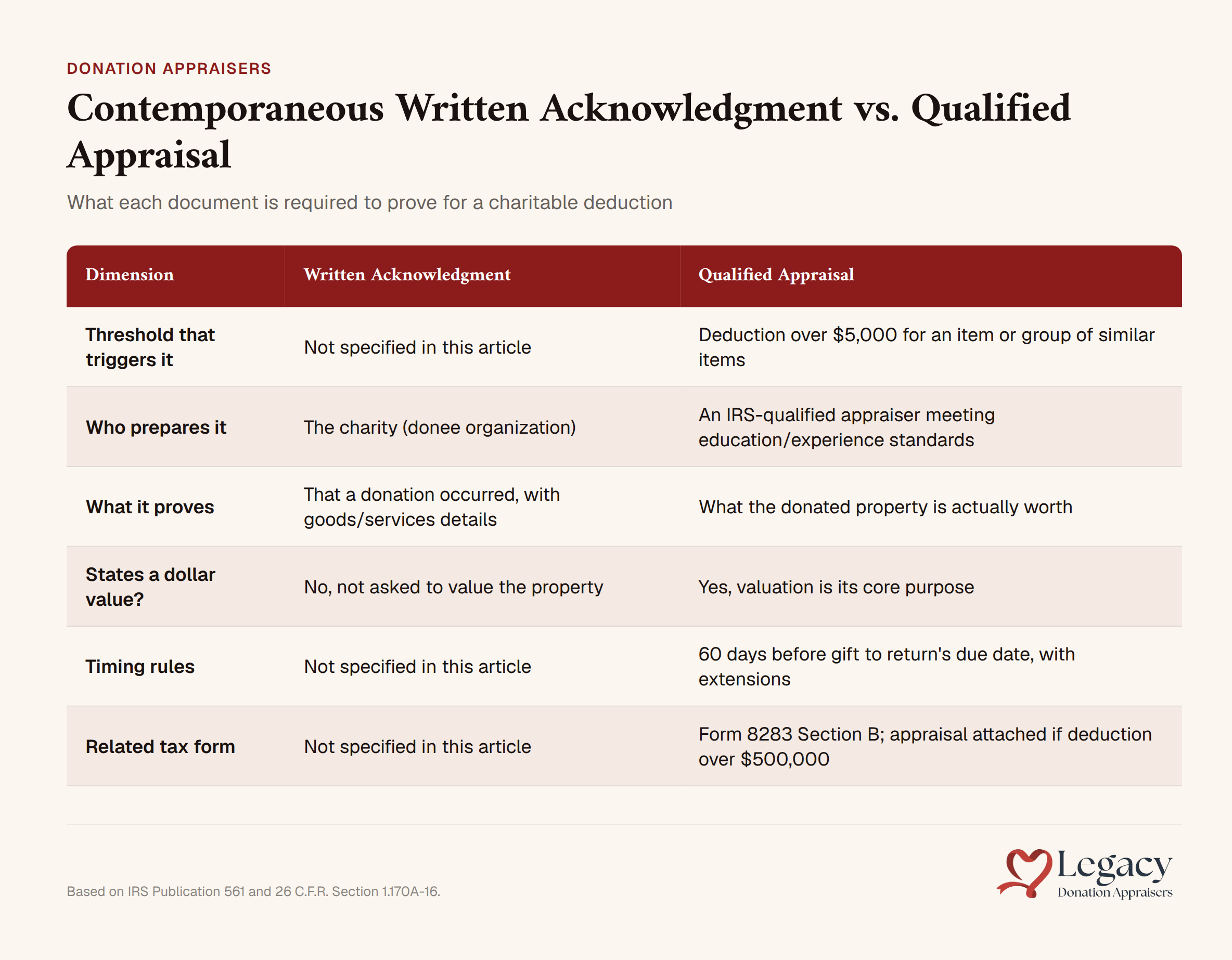
Side-by-Side: CWA vs Qualified Appraisal
Laid out next to each other, the differences are clear. The table below compares the two requirements across the factors that matter most when you're figuring out what you actually need.
| Factor | Written Acknowledgment (CWA) | Qualified Appraisal |
|---|---|---|
| Triggering threshold | $250 or more, per contribution | Generally more than $5,000, per item or group of similar items |
| Who prepares it | The receiving charitable organization | An independent, qualified appraiser |
| What it proves | That the gift was made and what, if anything, was received in return | What the donated property is worth |
| States a dollar value? | States cash amount; describes noncash property but does not value it | States the appraiser's fair market value conclusion |
| Timing | By the earlier of filing the return or its extended due date | Prepared no earlier than 60 days before the gift, received by the extended filing deadline |
| Tax form connection | Retained by the donor; not filed with the return | Supports Form 8283, Section B; the full report attaches above $500,000, with exceptions |
When You Need Both at the Same Time
For most noncash gifts over $5,000, both requirements apply simultaneously, and neither one shrinks the other. The IRS Form 8283 instructions walk through how the appraisal summary and the donee's signature fit together, and it's worth reading before you finalize a large gift.
Example: A donor gives a collection of vintage guitars appraised at $18,000 to a museum. The museum sends a letter confirming receipt of "a collection of 12 vintage guitars" and states that no goods or services were provided in return, satisfying the acknowledgment requirement. Separately, the donor's qualified appraiser documents condition, provenance, and comparable sales to support the $18,000 conclusion, and the donor attaches a completed Form 8283, Section B, to the return. Both documents are necessary. Either one alone leaves the deduction exposed.
Pro tip: request the acknowledgment letter as soon as the charity takes possession of the property, and start the appraisal engagement early enough that the report is finished well before your filing deadline. Waiting until tax season to find an appraiser is the most common cause of missed deadlines on large gifts.
The Donee Signature on Form 8283 Isn't a Value Endorsement
This is where the misconception runs deepest. When a charity signs Section B, Part IV of Form 8283, many donors assume the organization is vouching for the claimed value. It isn't. The donee's signature acknowledges receipt of the described property on the stated date; it says nothing about whether the appraiser's value conclusion is accurate or reasonable. If you want more detail on how that signature works and whether you must attach the full report, our FAQ on attaching an appraisal to Form 8283 covers the specific attachment rules.
The appraiser's signature on the same form, by contrast, does carry weight. By signing, the appraiser represents that the valuation was performed according to generally accepted appraisal standards and that they meet the IRS's qualification requirements. That's the professional judgment the IRS is actually relying on when it evaluates a noncash deduction.
Protect Your Deduction with Both Pieces of Paper
A charity's thank-you letter and an appraiser's valuation report answer two different questions, and the IRS checks both independently. The charitable contribution written acknowledgment requirement confirms the gift happened and what came back in exchange; the qualified appraisal requirement, triggered above $5,000 in claimed value, confirms what the gift is actually worth. Skipping either one, or assuming one covers the other, is one of the fastest ways to lose a noncash deduction on audit.
If you're planning a significant noncash gift this year, get the acknowledgment letter in writing early and line up a qualified appraiser well before your filing deadline. Our team prepares USPAP-compliant, IRS-qualified appraisals across personal property, vehicles, fine art, and business interests, built specifically to support Form 8283 filings. You can request an appraisal to get your documentation started.
This article is provided for general informational purposes only and does not constitute legal, tax, or financial advice. Readers should consult a qualified attorney or CPA regarding their specific circumstances.