
Blog
Donate After Signing a Purchase Agreement? IRS Rules
Can you donate stock after signing a purchase agreement? Under the IRS anticipatory assignment of income doctrine, usually no. Timing, Hoensheid, and how a gift holds up.
Published
If you have already signed a binding agreement to sell your shares or your interest in a company, giving that asset to charity now will usually not avoid the capital gain. The IRS can treat the transaction as if you sold the asset yourself and then donated the cash. The doctrine behind this is called the anticipatory assignment of income, and the timing of the gift decides almost everything.
This guide explains where courts have drawn the line, why a signed agreement is generally past it, how donor-advised fund sponsors handle late gifts, and what the appraisal has to show when the timing is right.
The Anticipatory Assignment of Income Doctrine Taxes the Person Who Earned the Gain
The idea is old and simple: you cannot avoid tax on income you have already earned by handing over the right to collect it. For appreciated property, courts ask whether the right to the sale proceeds had already ripened by the time of the gift. If it had, the donor is taxed on the gain even though the charity receives the money.
Courts decide this on the "realities and substance" of the deal, not the paperwork alone. In Jones v. United States, 531 F.2d 1343 (6th Cir. 1976), the Sixth Circuit taxed the donor when the transaction was "practically certain to occur," even though there was a remote chance it would be abandoned. In Ferguson v. Commissioner, 174 F.3d 997 (9th Cir. 1999), stock given to charity after more than half of the company's shares had been tendered in a merger had already become a fixed right to receive cash, and the gain belonged to the donors.
Courts Respect a Gift Made While the Sale Is Still Uncertain
Giving appreciated property before a sale is not abusive on its own. The Tax Court said in Humacid Co. v. Commissioner, 42 T.C. 894 (1964) that the donor's form will be respected when the donor "gives the property away absolutely and parts with title thereto before the property gives rise to income by way of a sale."
Redemptions get similar treatment. In Palmer v. Commissioner, 62 T.C. 684 (1974), a gift of stock to a foundation that the corporation redeemed the next day was respected as a gift of stock, not of redemption proceeds. The IRS then said in Rev. Rul. 78-197 that it would treat the proceeds as the donor's income only if the charity was legally bound, or could be compelled, to surrender the shares. The Tax Court has since said it does not treat that ruling as the test. In Dickinson v. Commissioner, T.C. Memo. 2020-128, it respected gifts of shares to a donor-advised fund followed by redemptions because the redemption "was not a fait accompli at the time of the gift."
Hoensheid Shows a Gift Can Fail Even Before Anything Is Signed
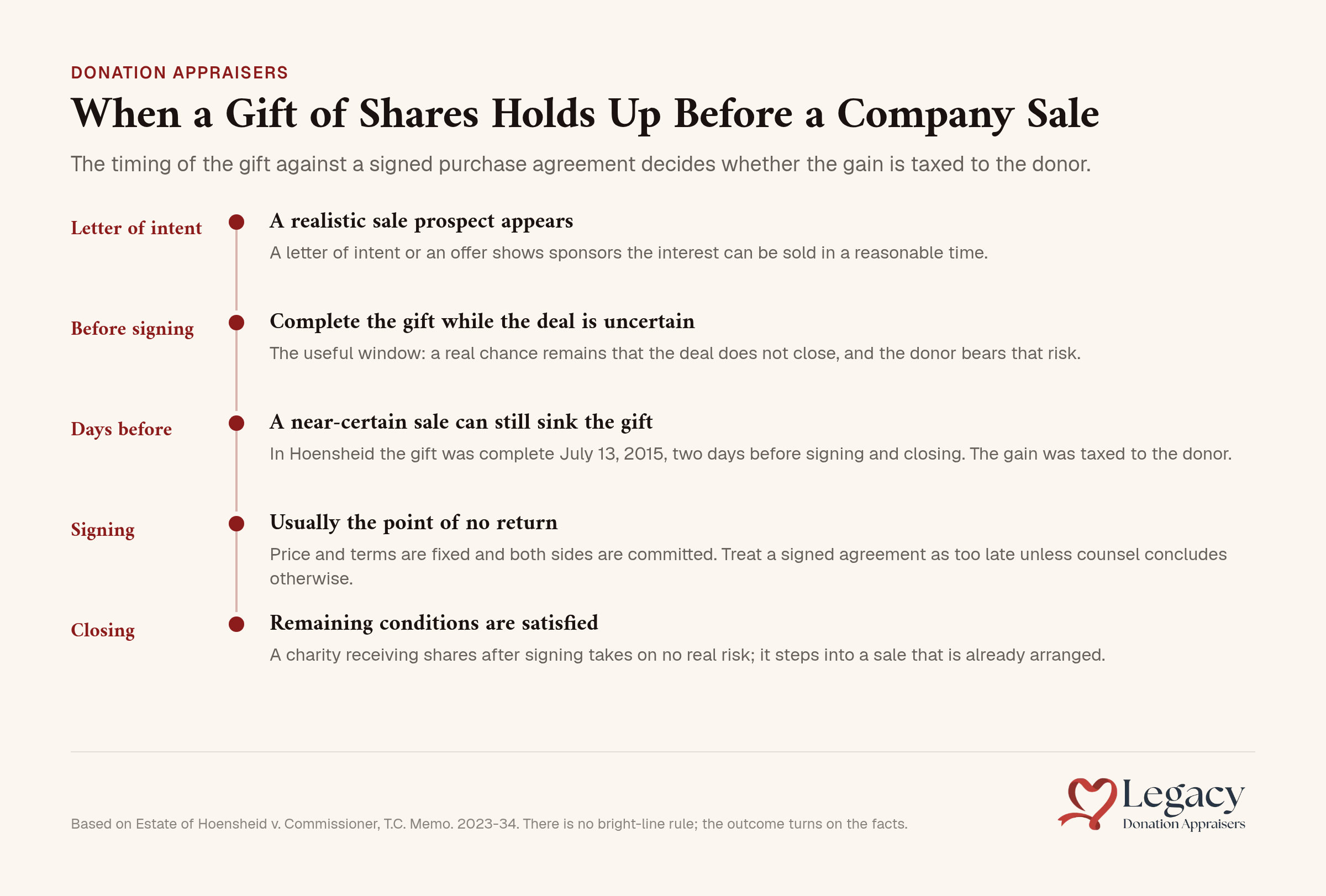
Estate of Hoensheid v. Commissioner, T.C. Memo. 2023-34 is the case advisors cite most. A shareholder gave 1,380 shares of his family's company to a donor-advised fund sponsor while a sale to a private equity buyer was being negotiated. Only a nonbinding letter of intent existed when he began the gift. The court found the gift was not complete until July 13, 2015, and the purchase agreement was signed and the sale closed on July 15.
The charity had no legal obligation to sell, but the court found the sale was a "virtual certainty" by the gift date, noting that "a donor must bear at least some risk" that the sale will not close. The gain was taxed to the donor. The court also denied his $3,282,511 deduction because his appraisal was not a qualified appraisal: it was prepared by the investment banker working on the deal, who was not a qualified appraiser, it left out his qualifications, and it used the wrong contribution date. (The appraisal failure is covered in more detail in Donating Private Company Stock to Charity: Lessons From the Hoensheid Case.)
If a gift two days before signing could fail, a gift after signing faces a steeper climb.
A Signed Purchase Agreement Usually Marks the Point of No Return
Once a buyer and seller sign a binding purchase and sale agreement, the price and terms are fixed and both sides are committed. What remains before closing is usually a list of conditions the parties expect to satisfy. A charity that receives the shares at that stage is not taking on any real risk that the deal falls through; it is stepping into a sale that is already arranged. That is the fact pattern the doctrine was built for.
There is no bright-line rule that a signature alone decides the question, and the outcome turns on the facts. One national donor-advised fund sponsor's published case study for donors of private C corporation stock puts it this way: "Generally, if a contribution is made after all the material terms of the sale are agreed upon and there is no material risk that the sale will not close, the IRS may conclude on audit that the contribution is an 'anticipatory assignment of income.'" For planning, treat a signed agreement as too late unless your tax counsel concludes otherwise on your specific terms.
Donor-Advised Fund Sponsors Review the Timing Before They Accept a Gift
Sponsors that accept private business interests review each gift before accepting it, and timing is one of the first things they ask about. In our experience working with donors and sponsors, some will not accept shares at all once a purchase and sale agreement is signed, because the gift would expose the donor to the outcome in Hoensheid. Others weigh the facts case by case. Ask the sponsor about its acceptance practice before you transfer anything.
Sponsors also tend to look for the opposite signal: a realistic prospect of a sale, such as a letter of intent or an offer, so they know the interest can be sold in a reasonable time. The useful window is the period after that prospect appears and before a binding agreement is signed, while a real chance remains that the deal does not close.
How to Time a Gift of Shares or a Business Interest Before a Sale
Gifts that hold up tend to share a few features:
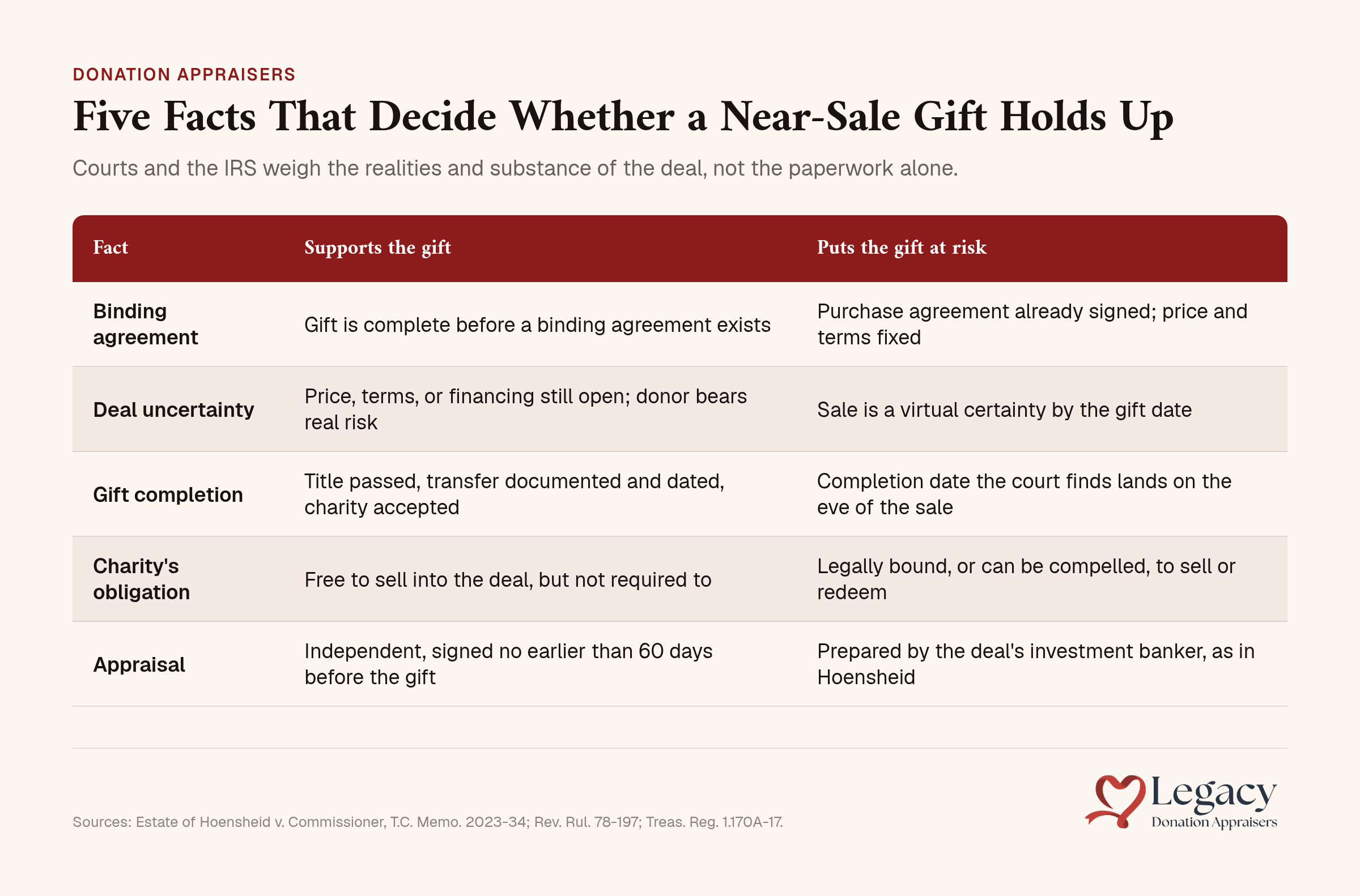
- The gift is complete before a binding agreement exists. Title has passed, the transfer is documented and dated, and the charity has accepted. In Hoensheid, the completion date the court found, not the date the donor intended, decided the case.
- The deal is genuinely uncertain on the gift date. Price, terms, or financing are still open, and the donor bears real risk that the sale does not happen.
- The charity is not obligated to sell. It can sell into the transaction, but no agreement compels it to.
- The appraisal is independent and timed correctly. A qualified appraisal must be signed and dated no earlier than 60 days before the contribution and no later than the due date of the return, including extensions (Treas. Reg. 1.170A-17), and it must be prepared by someone with no stake in the deal.
If the agreement is already signed, the usual result is a sale by you followed by a gift of cash, with the gain reported on your return. Talk with your CPA or attorney before closing about what that means for the year; do not try to backdate a transfer.
What the Appraisal Has to Show When a Sale Is on the Horizon
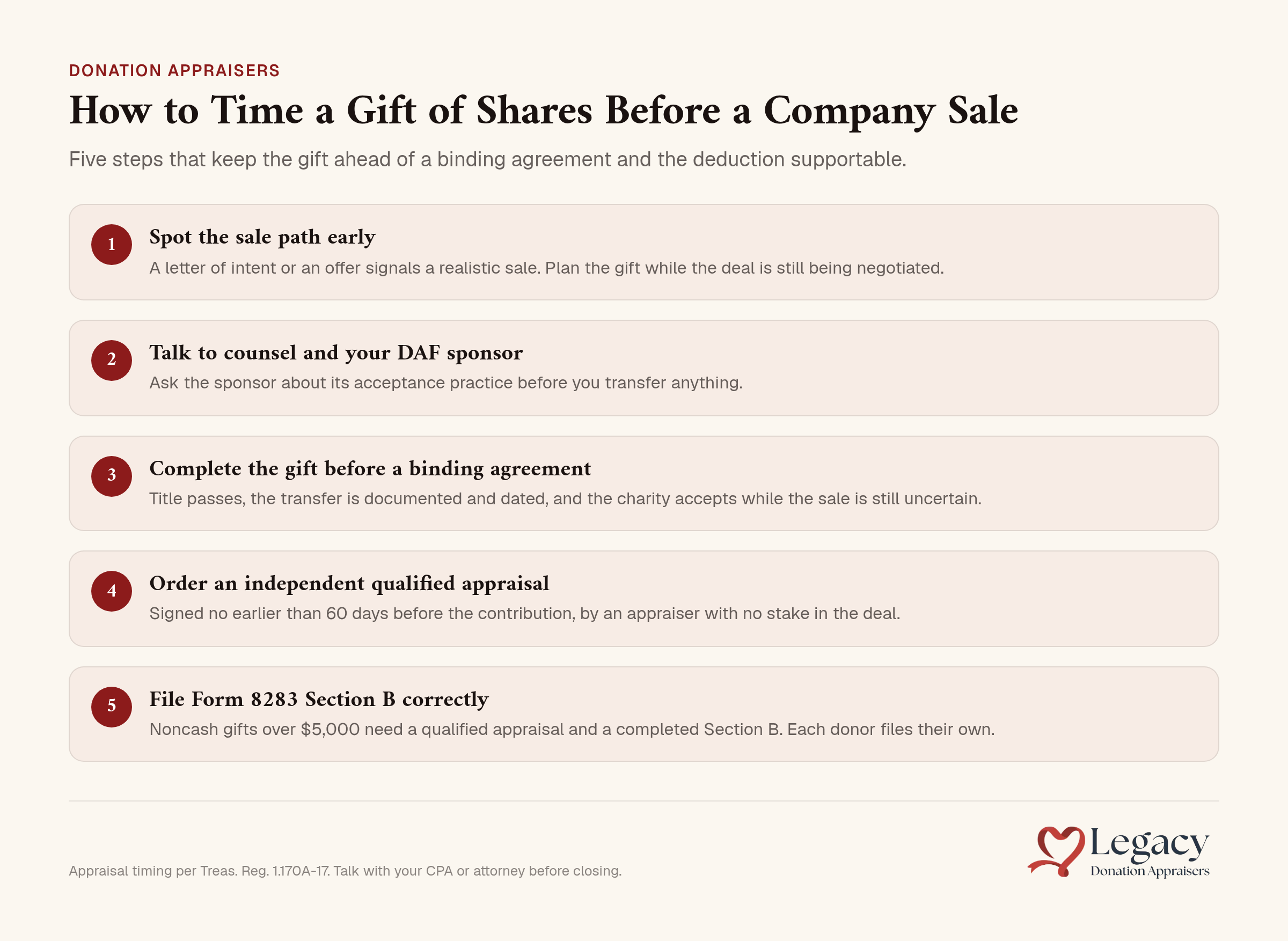
Any noncash gift valued over $5,000 needs a qualified appraisal and a completed Section B of Form 8283 (Treas. Reg. 1.170A-16; Form 8283 instructions). Over $500,000, the appraisal itself is attached to the return. The old exception that let some gifts of nonpublicly traded stock under $10,000 skip the appraisal applied only to contributions made before July 31, 2018.
The value is fair market value on the contribution date, and a pending sale is part of the evidence. A letter of intent dated before the valuation date tells the appraiser that a buyer exists and at roughly what price, which generally narrows the discount for lack of marketability. Without one, the appraiser has to rely on the company's circumstances on that date. Rights attached to the gift, such as an option for the charity to sell the interest back, can also affect value. A retroactive appraisal, prepared after the donor has learned how the sale turned out, still has to rely only on what was known or knowable on the contribution date.
When several owners give shares into the same transaction, each donor needs their own qualified appraisal and their own signed Form 8283, even if every gift is valued as of the same day. After the sale, the charity may also have to report it to the IRS on Form 8282, which is one more reason the appraised value needs to be supportable.
Donating After a Purchase Agreement: Common Questions
Can I donate shares after signing a letter of intent?
Often yes, if the letter of intent is nonbinding and the sale is still genuinely uncertain on the date the gift is complete. A letter of intent can help the valuation by showing a buyer exists, but Hoensheid shows that a gift made days before a near-certain closing can still be taxed to the donor. Complete the gift well before the deal is effectively done.
Does the charity have to sell my shares to the buyer?
It should not be obligated to. Courts and the IRS look at whether the charity was legally bound or could be compelled to sell or redeem the shares. A charity that is free to sell but not required to is one of the facts that supports respecting the gift.
If I donate after signing, do I still get a deduction?
Possibly, but the gain on the sale is likely taxed to you, as if you had sold the shares and donated the cash. The deduction still needs proper substantiation, including a qualified appraisal for property over $5,000. In Hoensheid the donor lost both: the gain was taxed to him and the deduction was denied for lack of a qualified appraisal.
Can the investment banker on my sale appraise the donated shares?
Generally not. The appraisal must come from a qualified appraiser, and Treas. Reg. 1.170A-17 sets out who qualifies. In Hoensheid, the deal's investment banker was found not to be a qualified appraiser. Use an independent appraiser who has no role in the transaction.
Get the Appraisal Started Before the Deal Moves Further
If a sale of your company or your interest is still being negotiated, the time to plan a gift is now. Our appraisers prepare qualified appraisals for donated business interests as of the contribution date, independent of the transaction, with a fixed fee quoted before work begins. Request an appraisal and tell us where the deal stands.
This article is provided for general informational purposes only and does not constitute legal, tax, or financial advice. Readers should consult a qualified attorney or CPA regarding their specific circumstances.