
Blog
Donated Car Tax Deduction Rules: Why Vehicles Follow a Different IRS Path
Donated car tax deduction rules follow a stricter, more formulaic path than the rules for art, jewelry, or household goods. This guide explains the $500 acknowledgment threshold, Form 1098-C, the gross-proceeds limit, and the exceptions that let a donor claim fair market value instead.
Donating a car, boat, or airplane to charity feels like it should work the same way as donating a painting or a coin collection. It doesn't. Congress carved out a separate statute for these three asset types, and the IRS built a reporting system around it that has almost nothing in common with the comparable-sales approach used for most other personal property. If you're planning a vehicle donation, understanding which set of rules applies, and why, determines whether your deduction survives a review.
Our vehicle appraisal service exists specifically because this statute trips up donors every year. The rest of this guide walks through why cars, boats, and airplanes are treated differently, what the $500 and $5,000 thresholds actually require, and when a boat or airplane donation still needs a full qualified appraisal.
Why Vehicles Get Their Own Rules
Motor vehicles, boats, and airplanes donated to charity are governed by IRC Section 170(f)(12), a statute that did not exist before 2004. Before that, donors claimed fair market value the same way they would for any other personal property. The American Jobs Creation Act of 2004 changed that, largely in response to donors claiming full "Blue Book" retail value for vehicles that charities then sold at auction for a fraction of that price.
The IRS press release accompanying the 2005 guidance was blunt about the problem: some donation program operators told donors they could deduct the full trade-in or dealer retail value, when the law only ever allowed fair market value, and even that is now capped for most vehicle donations. The result is a statute that trades flexibility for predictability. Instead of asking "what would a willing buyer pay," the rule usually asks "what did the charity actually get for it."
The $500 Threshold and Form 1098-C
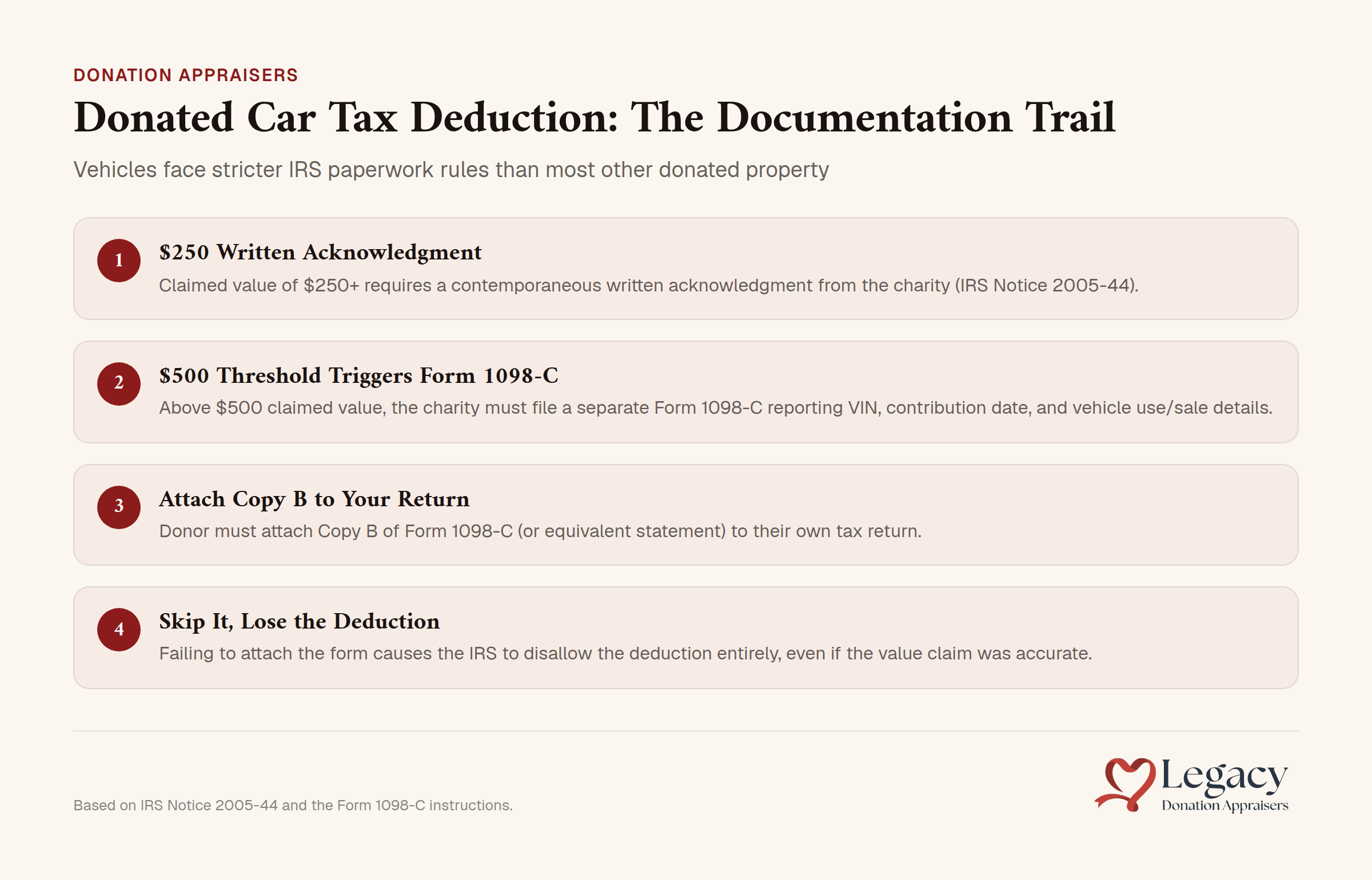
For a qualified vehicle (a car, boat, or airplane) with a claimed value of $250 or more, the donor needs a contemporaneous written acknowledgment from the charity, per IRS Notice 2005-44. That threshold alone isn't unusual; general charitable rules require an acknowledgment at $250 for any donation.
What makes vehicles different is what happens above $500. Once the claimed value exceeds $500, the charity is required to file a separate Form 1098-C for that specific vehicle, and the donor must attach Copy B of that form (or an equivalent statement) to their own return. The Form 1098-C instructions spell out what the form has to report:
- The vehicle's identification number and description
- The date of the contribution
- Whether the charity sold the vehicle, used it significantly, materially improved it, or transferred it to a needy individual
- The gross proceeds from any sale, and the date it occurred
Skip the attachment step and the IRS will disallow the deduction outright, even if the underlying value claim was accurate. There is no equivalent attachment requirement for most other personal property donations under $500,000.
The General Rule: Deduction Limited to Gross Proceeds
For most vehicle donations, the deduction isn't based on fair market value at all. It's based on what the charity actually received when it sold the vehicle.
According to IRS Publication 526, if you donate a car, boat, or airplane and the charity later sells it without significant use, improvement, or a qualifying below-market transfer, your deduction is limited to the gross proceeds from that sale, as reported on Form 1098-C. If the charity sells your donated boat for $2,400 at auction, your deduction is $2,400, regardless of what a price guide might have said it was worth the week before.
This is the single biggest difference between vehicles and other donated property. A donated painting, a coin collection, or a set of antique furniture is valued once, at the time of the gift, using comparable sales and market data. A donated vehicle is often valued after the fact, based on what it fetched at sale.
The Three Exceptions That Let You Claim Fair Market Value
The gross-proceeds rule isn't absolute. IRS guidance carves out specific situations where a donor can still claim fair market value instead, and Form 1098-C is where the charity documents which one applies.
- Significant intervening use. If the charity uses the vehicle itself in a meaningful way before selling or disposing of it (a food bank using a donated van to deliver meals, for example) rather than immediately selling it, the donor may deduct fair market value.
- Material improvement. If the charity makes substantial repairs that meaningfully increase the vehicle's value before selling it, not simple cleaning or a paint job, fair market value applies instead of the eventual sale price.
- Below-market transfer to a needy individual. If the charity gives or sells the vehicle at a significantly reduced price to someone in need, and doing so furthers the charity's mission of providing transportation, the donor can claim fair market value.
Even within these exceptions, fair market value isn't unlimited. The IRS guidance on vehicle donation rules caps the allowable value at the private-party sale price, not the higher dealer retail or trade-in figures that price guides also publish. That distinction alone accounts for a meaningful share of overstated vehicle-donation deductions.
Example: A donor gives a used pickup truck to a rural fire department that uses it for two years hauling equipment before eventually retiring it. Because the department made significant intervening use of the truck rather than selling it right away, the donor can deduct the truck's fair market value at the time of the gift, not a later resale price, subject to the private-party value cap.
Boats and Airplanes: Same Statute, Different Valuation Challenges
Boats and airplanes are "qualified vehicles" under the same statute as cars, which means the $500 threshold, Form 1098-C, and the gross-proceeds default all apply to them too. But valuing a boat or an airplane in the first place is a different exercise than pulling a number from a used-car price guide.
General IRS guidance on donated property flags that boat valuation should rely on an appraisal from a marine surveyor, because a boat's physical condition drives its value far more heavily than a comparable car's does. Hull integrity, engine hours, rigging condition, and prior storage all shift a boat's worth in ways that a standard price guide simply can't capture. The same logic extends to airplanes, where airworthiness, engine and airframe hours, and avionics condition carry outsized weight.
That's a meaningful practical point for donors: even though the tax mechanics (1098-C, the $500 threshold, gross proceeds) are identical across cars, boats, and airplanes, the valuation work behind a boat or airplane appraisal looks a lot more like the process used for other complex personal property than it does like looking up a car's trade-in value.
When the $5,000 Qualified Appraisal Rule Still Applies
Here's where the vehicle rules rejoin the general personal property rules. If your vehicle donation is limited to the charity's gross sale proceeds, you generally don't need a written appraisal at all, because the deduction amount comes from the sale, not from an opinion of value.
But the moment a boat, airplane, or car donation falls into one of the fair-market-value exceptions (significant use, material improvement, or a below-market transfer to a needy individual), or the claimed value is otherwise based on fair market value rather than gross proceeds, the general rules under Publication 561 come right back into play. If the claimed fair market value exceeds $5,000, a qualified appraisal is required, and Form 8283 Section B must be completed and signed by both the qualified appraiser and an authorized official of the receiving charity.
This is easy to miss. Donors sometimes assume that because vehicles have their own statute, the $5,000 appraisal threshold from Publication 561 never applies to them. It does, but only once the deduction is no longer tied to a straightforward gross-proceeds sale.
How This Differs from Art, Jewelry, and Other Personal Property
For most donated personal property, none of the vehicle-specific machinery above exists. A donor giving away artwork, jewelry, sports memorabilia, or a coin collection follows the general path: fair market value is established through comparable sales, market data, and expert judgment, a qualified appraisal is required once the claimed value exceeds $5,000, and Form 8283 documents the transaction. There's no separate donee reporting form, no gross-proceeds substitution, and no $500 acknowledgment trigger unique to that asset type.
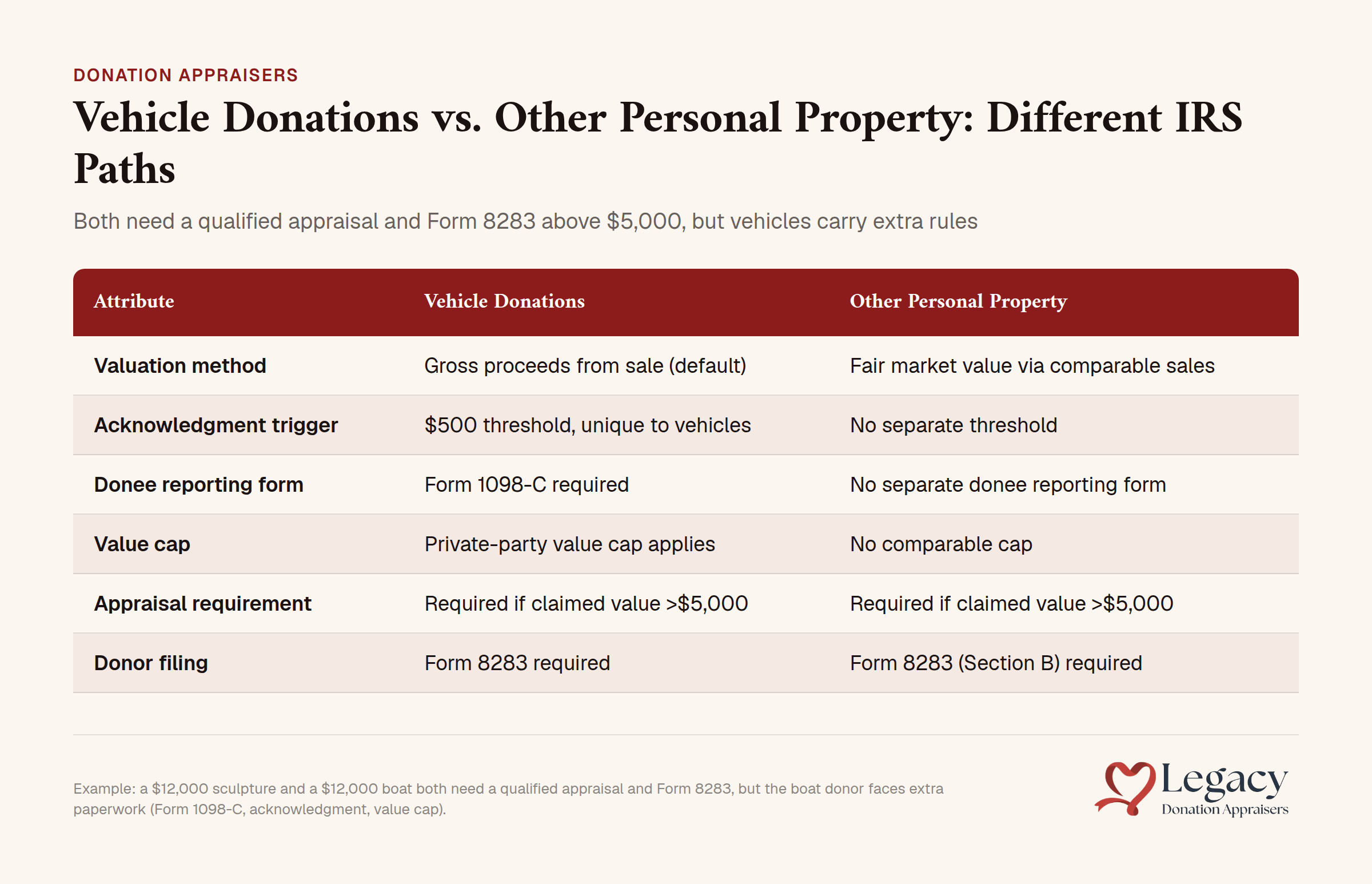
The practical upshot: a donor giving a $12,000 sculpture and a donor giving a $12,000 boat both need a qualified appraisal and a completed Form 8283, but they arrive there through different rules, and the boat donor has an extra layer of paperwork (Form 1098-C, the charity's acknowledgment, and the private-party value cap) that the sculpture donor never sees.
Getting the Paperwork Right Before you File
The vehicle donation rules exist because the IRS watched a pattern of inflated deductions and responded with a formula-driven fix. That fix works well for straightforward donations where the charity sells the vehicle quickly, but it creates real complexity the moment a donation involves intervening use, a material improvement, or a below-market transfer.
Before claiming a deduction for a donated car, boat, or airplane, confirm which regime applies to your specific gift, and if fair market value is in play rather than gross proceeds, treat the $5,000 appraisal threshold the same way you would for any other personal property donation. Getting the sequence backward, claiming fair market value without the required documentation, or skipping Form 1098-C entirely, is one of the more common reasons vehicle donation deductions get disallowed.
This article is provided for general informational purposes only and does not constitute legal, tax, or financial advice. Readers should consult a qualified attorney or CPA regarding their specific circumstances.