
Blog
Cost, Comparable Sales, or Replacement Value: Picking the Right Fair Market Value Method
The IRS recognizes several ways to support a donated item's fair market value, but cost or selling price, comparable sales, and replacement cost each fit different donation scenarios. This guide shows which method matches your situation and where replacement cost claims most often get an appraisal rejected.
Donors claiming a deduction for property given to charity often assume there is one correct way to price the gift. There isn't. Federal regulations describe fair market value as the price a willing buyer would pay a willing seller, with neither under pressure to act and both reasonably informed, and IRS Publication 561 lays out several kinds of evidence an appraiser can use to arrive at that price. Three approaches come up constantly in personal property donation files: the item's own cost or recent selling price, sales of comparable property, and replacement cost. Picking the wrong one, or leaning on one that doesn't fit the facts, is a common reason a deduction gets challenged.
What the IRS Actually Looks at When Weighing FMV Evidence
No single formula produces fair market value. Instead, the IRS treats a list of factors as relevant evidence, and an appraiser weighs them against each other for the specific item being valued.
Among the factors IRS Publication 561 identifies as relevant to a fair market value determination:
- The cost or actual selling price of the item itself, if that transaction is recent and reliable.
- Sales of comparable properties, adjusted for differences in condition, date, and location.
- Replacement cost, when there is a reasonable relationship between that cost and market value.
- Opinions of qualified, disinterested experts who are familiar with the type of property.
The weight given to each factor shifts with the facts. A car has an active resale market, so comparable sales usually carry the most weight. A one-of-a-kind sculpture has no resale market at all, so an appraiser leans harder on expert opinion and, sometimes, replacement cost. Understanding which method the facts support, rather than which one is easiest to calculate, is the real skill in a donation appraisal.
Method 1: Cost or Selling Price of the Donated Property
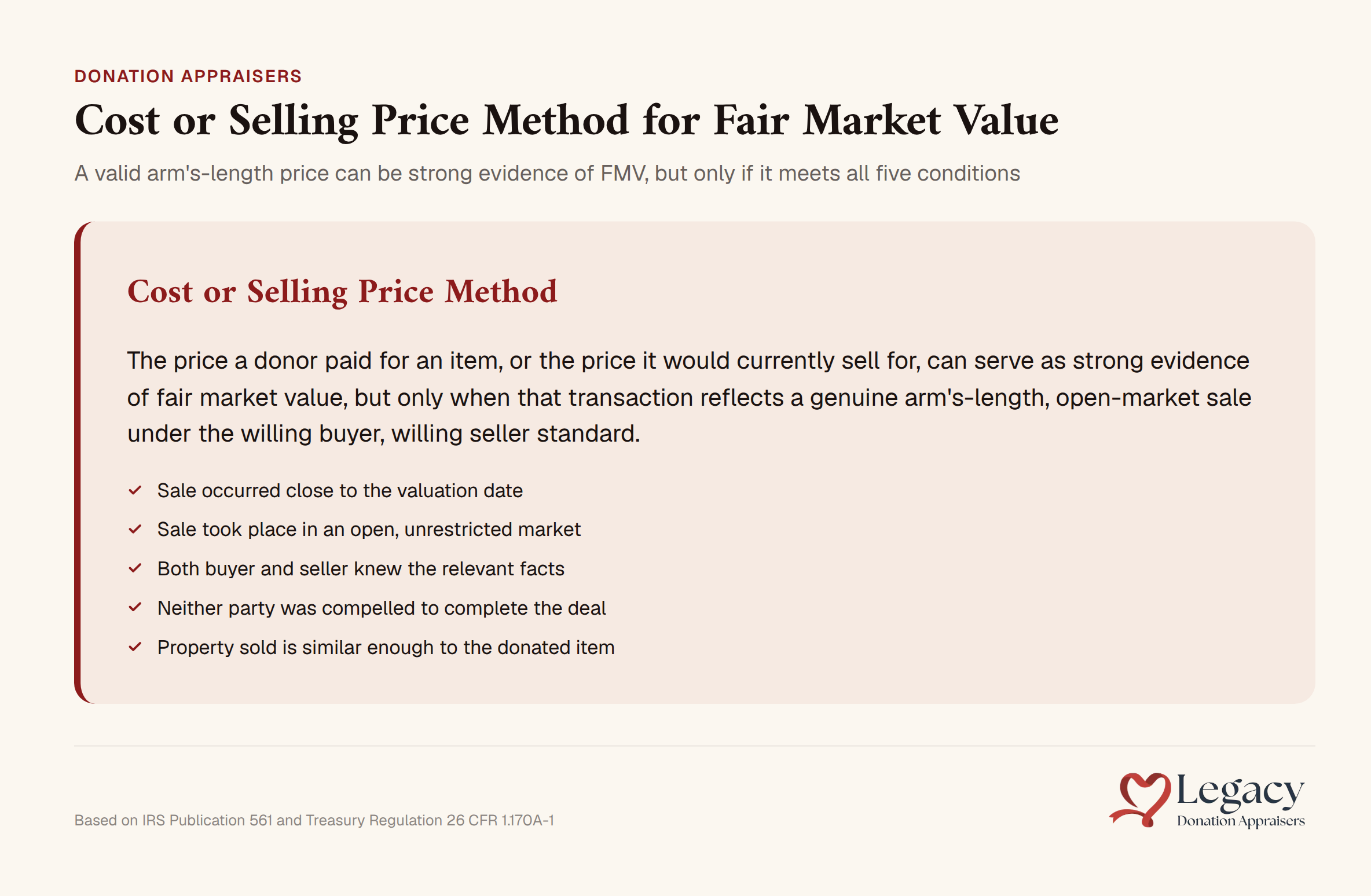
The price the donor paid for an item, or the price it would currently sell for, is often the strongest single piece of evidence of fair market value, but only under specific conditions. The transaction has to actually reflect the open market.
Treasury regulations define fair market value using the willing buyer, willing seller standard, and that standard only holds up when the sale being relied on was itself conducted at arm's length. IRS Publication 561 lists the conditions that make a cost or selling price reliable:
- The sale happened close to the valuation date, not months or years earlier.
- It took place in an open market, not one that was artificially supported or restricted.
- Both the buyer and seller knew the relevant facts about the property.
- Neither party was compelled to complete the transaction.
- The property involved in the sale is similar enough to the donated item for the price to be meaningful.
Watch out: Liquidation sales, forced sales, and sales of small or restricted lots usually fail this test. A price generated under distressed or unusual circumstances does not represent what a typical, unpressured buyer would pay, so it cannot stand in for fair market value even if it is the most recent number available.
This is also the method most frequently abused in promoter-driven donation schemes. A well-documented pattern involves gem or book promoters who sell inventory to donors at an inflated "list" price, then help arrange a donation at that same inflated figure, when the promoter was actually a willing seller at a much lower price to ordinary buyers. If a promoter sells similar lots of books for either $10,000 or $30,000 depending entirely on what the buyer is willing to negotiate, and the promoter routinely accepts $10,000, then $10,000, not $30,000, is the figure that reflects what the property would fetch from a willing seller in the open market. The stated purchase price on an invoice is not automatically the fair market value; it is only evidence, and it has to survive the same arm's-length test as any other sale.
Best fit: recently purchased items with a documented, arm's-length transaction, and property a donor's business regularly sells to the public at an established price.
Method 2: Sales of Comparable Properties
Comparable sales analysis estimates fair market value by looking at verified sales of similar property and adjusting for differences in condition, timing, and location. It is usually the strongest method when an active market exists: vehicles, land, collectibles with a trading history, and most used equipment all fall here.
This site covers the mechanics of building a defensible comparable sales case, including how much weight recency and similarity carry, in a separate guide to the comparable sales method. The short version: the IRS weighs each comparable by how similar it is to the donated property, how close the sale date falls to the valuation date, and whether the transaction was genuinely arm's length. A charity auction result, for what it's worth, generally does not qualify as reliable comparable-sale evidence, since auction bidding dynamics differ from an ordinary market sale.
Method 3: Replacement Cost (and Why It Rarely Equals FMV)
Replacement cost is the amount it would take to buy, build, or manufacture property similar to the donated item as of the valuation date. It is a legitimate factor in a fair market value analysis, but it is also the most misapplied one, because most donors assume "what it would cost to replace this" and "what I can deduct" are the same number. They usually are not.
IRS guidance is direct about this: there must be a reasonable relationship between replacement cost and fair market value before the figure can be used, and in most cases, no such relationship exists. A retail replacement price typically bundles in profit margin, overhead, warranty coverage, and shipping, none of which a buyer purchasing the donor's actual used item in the secondary market would pay for.
How Replacement Cost Is Supposed to Be Calculated
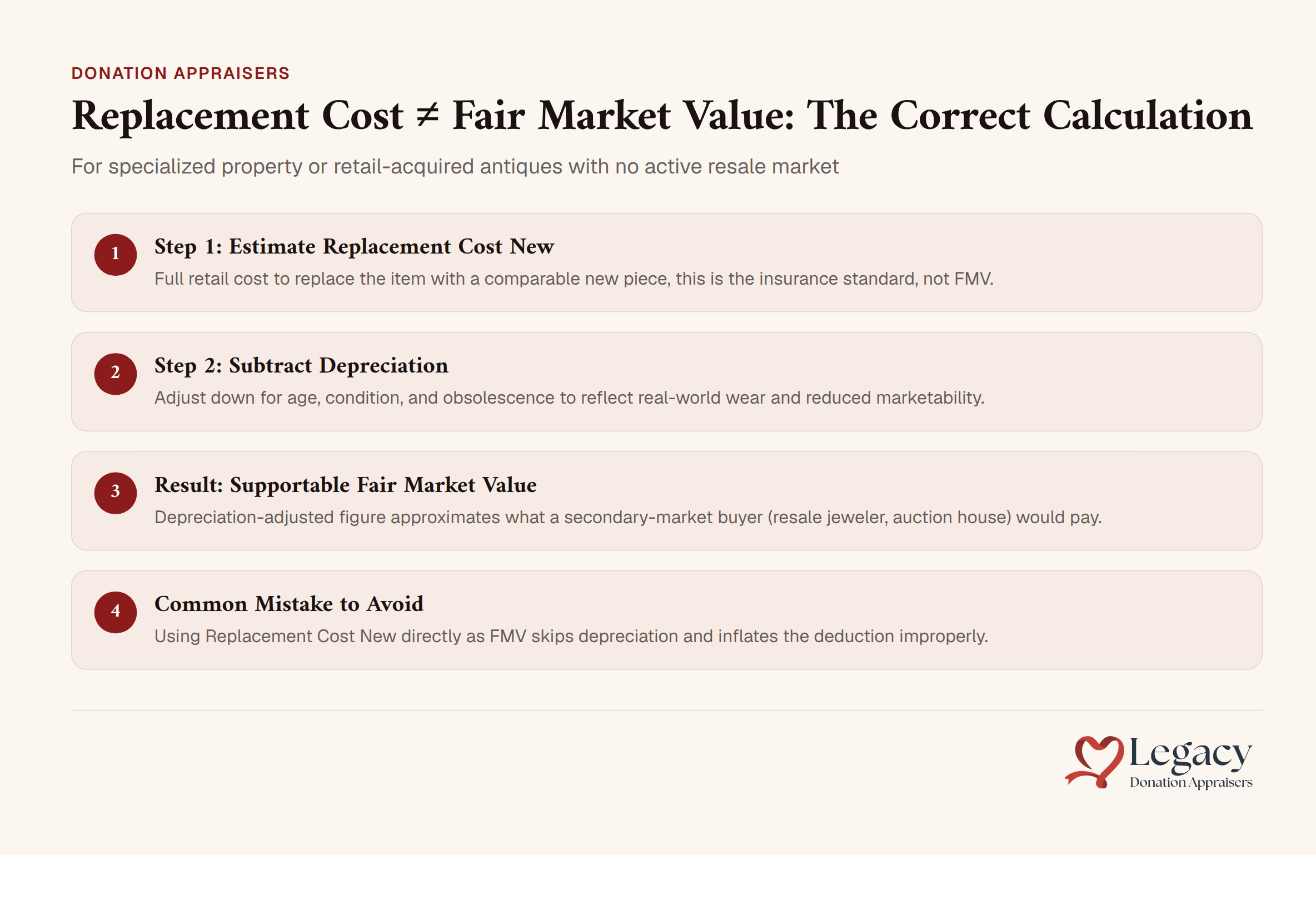
When replacement cost is appropriate at all, it is never used as a raw number. The correct calculation starts with the estimated replacement cost new, the price to buy a brand-new equivalent today, and then subtracts depreciation attributable to the donated item's actual age, condition, and any functional or economic obsolescence. An appraiser has to be able to show the relationship between that depreciated figure and the item's fair market value, not just present the replacement cost new as the deduction amount.
Example: A donor gives a 15-year-old piece of specialized lab equipment. A new equivalent model costs $40,000 today. After accounting for the equipment's age, wear, and the fact that two newer generations of the technology have since made it less desirable, the appraiser might support a fair market value closer to $6,000, not $40,000. The replacement cost new was only the starting point of the analysis, not the conclusion.
When Replacement Cost Tracks FMV More Closely
There are exceptions. For certain antiques and collectibles, replacement cost and fair market value can land close together, because the most common market for that category genuinely is the retail market: antique shops, specialty dealers, and galleries. If a donor gives a piece of antique furniture that would typically be acquired through that same retail channel, the retail replacement price may reasonably approximate what a buyer would pay. That relationship has to be demonstrated item by item; it is never assumed.
Replacement Cost Is Not the Same as Insurance Value
One of the most common mix-ups in a donation file involves jewelry. A donor's insurance policy lists a "replacement value" for a ring or necklace, and the donor assumes that figure is also the item's fair market value for a tax deduction. It generally is not. Insurance replacement value is typically set at the full retail cost of replacing the item with a comparable new piece, which protects the policyholder against total loss. Fair market value, by contrast, reflects what a buyer in the item's actual secondary market, often resale jewelers or auction houses rather than a retail jewelry counter, would actually pay. These two figures can differ substantially, and an appraiser working on a donation has to value the item on the secondary market standard, not the insurance standard.
Best fit: specialized property with no active resale market, where a reasoned, depreciation-adjusted replacement figure is the best available evidence, and certain antiques or collectibles customarily acquired at retail.
The Role of Professional Appraiser Opinions
When none of the market-based methods produce a clean answer on their own, an appraiser's professional judgment becomes its own factor in the analysis. The International Society of Appraisers notes that a qualified appraiser's opinion carries weight in proportion to the appraiser's knowledge of the specific property type and the thoroughness of the supporting analysis. An opinion backed by documented comparable research, condition reports, and market data holds up; a bare number with no analysis behind it does not.
This is why a qualified appraisal rarely relies on just one of these three methods in isolation. Our appraisers, who hold credentials with organizations such as the ASA, ISA, and AAA, typically cross-check the strongest available method against at least one other data point before finalizing a value, and every report is prepared in accordance with USPAP.
Choosing the Right Method for Your Donation
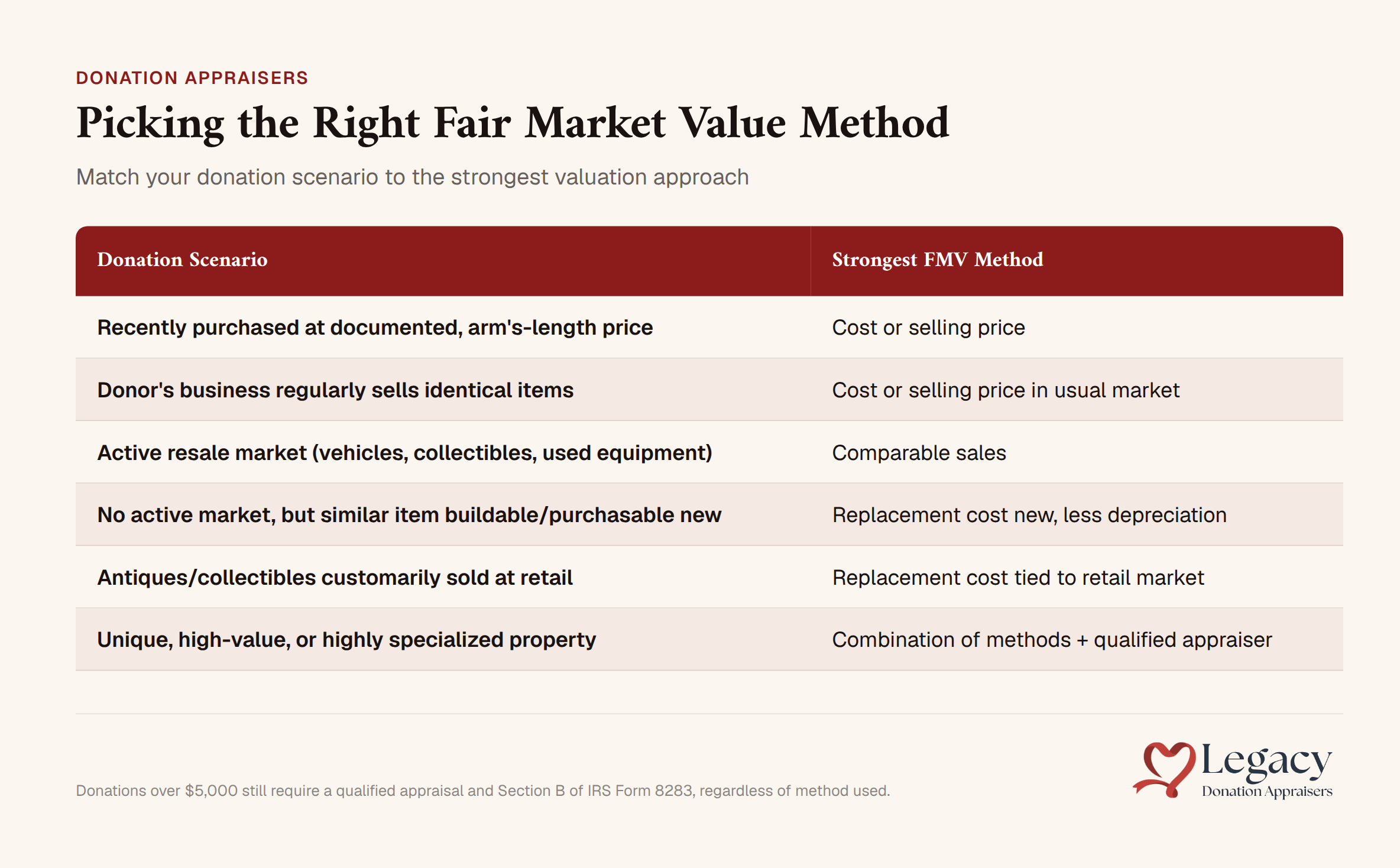
The fastest way to know which method applies is to ask what kind of market exists for the item being donated.
| Donation scenario | Generally strongest method |
|---|---|
| Item purchased recently at a documented, arm's-length price | Cost or selling price |
| Donor's business regularly sells identical items | Cost or selling price in the donor's usual market |
| Active resale market exists (vehicles, common collectibles, used equipment) | Comparable sales |
| No active resale market, but a similar item can be built or purchased new | Replacement cost new, less depreciation |
| Antiques or collectibles customarily bought and sold at retail | Replacement cost, if tied to the retail market |
| Unique, high-value, or highly specialized property | Combination of methods plus a qualified appraiser's opinion |
None of these methods substitute for proper substantiation. A donation over $5,000 still requires a qualified appraisal and a completed Section B of IRS Form 8283, regardless of which valuation method the appraiser ultimately relies on.
Getting the Method Right the First Time
The three methods described in IRS Publication 561 are not competing options a donor picks based on which produces the biggest number. Each one is evidence that is only as strong as the market facts behind it, and an appraiser's job is matching the right evidence to the right asset. Cost or selling price works when a recent, arm's-length transaction exists. Comparable sales work when an active market can be documented. Replacement cost works only when it can be tied, through depreciation analysis, back to what a buyer would actually pay, and it is never a stand-in for insurance value.
Getting this wrong doesn't just risk an inflated number; it risks the entire deduction if the IRS finds the valuation unsupported. If you're preparing a donation of personal property and want a defensible, USPAP-compliant valuation built on the right method for your item, request an appraisal and our team will scope the right approach before work begins.
This article is provided for general informational purposes only and does not constitute legal, tax, or financial advice. Readers should consult a qualified attorney or CPA regarding their specific circumstances.