
Blog
Gold and Silver Coin Appraisal for Donation: What IRS Form 8283 Requires
A gold and silver coin appraisal for donation is legally required once your claimed deduction passes $5,000, and the IRS treats a coin collection as one aggregated item. Here's how coin value gets determined, what documentation to gather, and what a compliant appraisal report includes.
Donating an inherited coin collection or a set of gold and silver coins you've held for years can generate a meaningful tax deduction, but the IRS does not simply accept whatever number you write on your return. Once your claimed value crosses a specific threshold, federal law requires a written appraisal from a qualified appraiser before you can claim the deduction. This guide walks through when that requirement kicks in, how coin value actually gets determined, what to gather before your appraisal, and what a compliant report looks like.
Why the IRS Requires a Qualified Appraisal for Coin Donations
A gold and silver coin appraisal for donation becomes a legal requirement, not just a good idea, once your claimed deduction for the coins exceeds $5,000. Below that line, different (lighter) documentation rules apply, but past it, the IRS wants a signed appraisal in hand before you file.
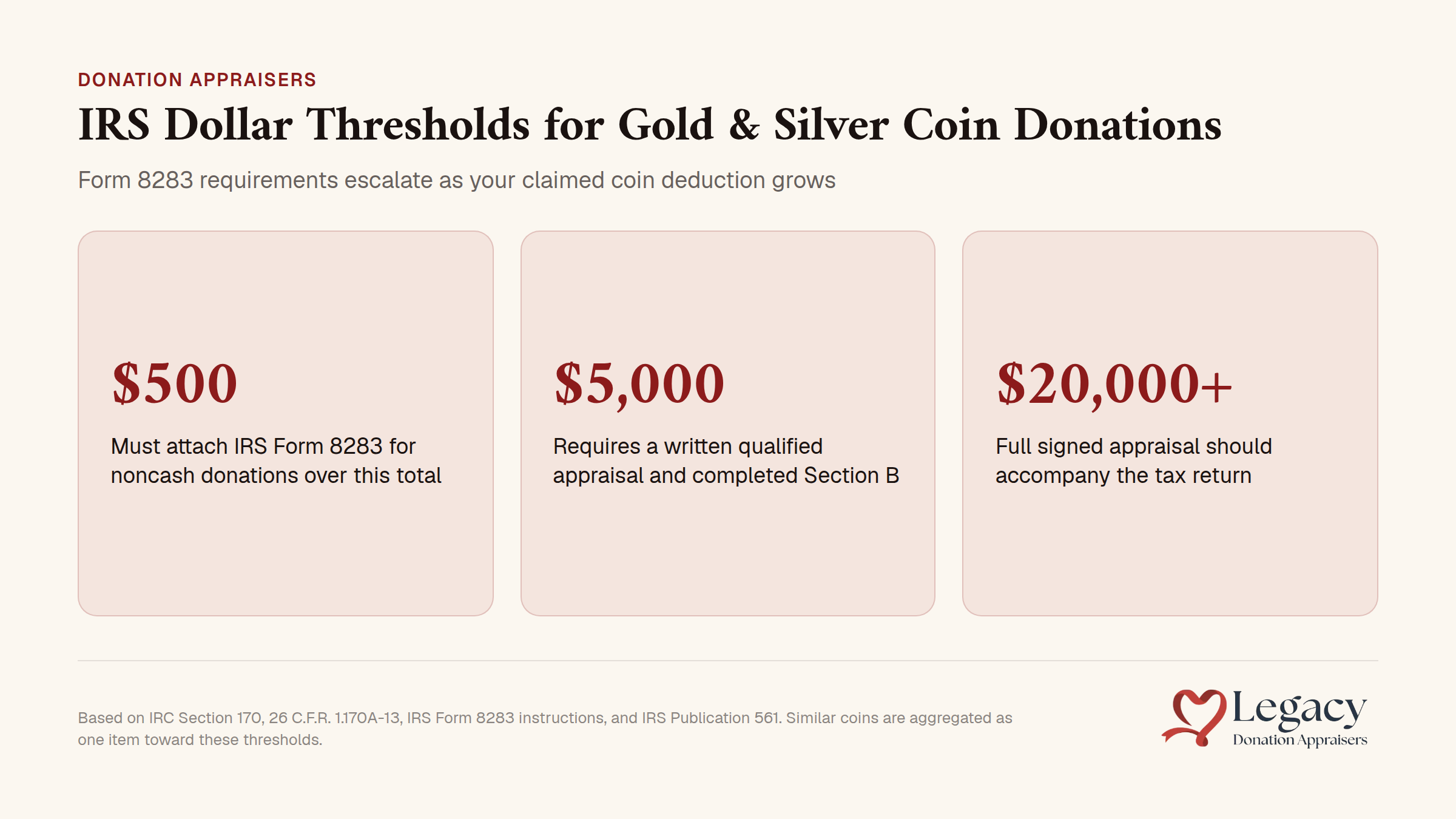
The framework comes from IRC Section 170 and its regulations at 26 C.F.R. Section 1.170A-13, which spell out exactly what counts as a qualified appraisal and who qualifies as an appraiser. Three thresholds matter for coin donors:
- Over $500: You must complete and attach IRS Form 8283 to your return for any noncash donation, including coins, once your total noncash contributions for the year pass $500.
- Over $5,000: A single item or a group of similar items, such as a coin collection, requires a written qualified appraisal and a completed Section B of Form 8283, per the IRS Form 8283 instructions.
- $20,000 and above: The IRS strongly expects a complete copy of the signed appraisal to accompany the return rather than just being kept on file.
The aggregation rule trips up a lot of donors. If you're giving away 40 individual coins worth $200 each, that's still a $8,000 donation of similar property, and the IRS treats the entire collection as one item for purposes of the $5,000 threshold, according to IRS Publication 561. You can't sidestep the appraisal requirement by valuing each coin separately or splitting the gift across tax years if the coins are functionally one collection. If you're unsure whether your total pushes you past the line, our guide on what happens if your donation is worth over $5,000 walks through the mechanics in more detail. Our coin appraisal service for charitable donation is built around exactly this scenario: aggregated collections that need one defensible, IRS-ready valuation.
How Coin Value Is Determined for a Donation Appraisal
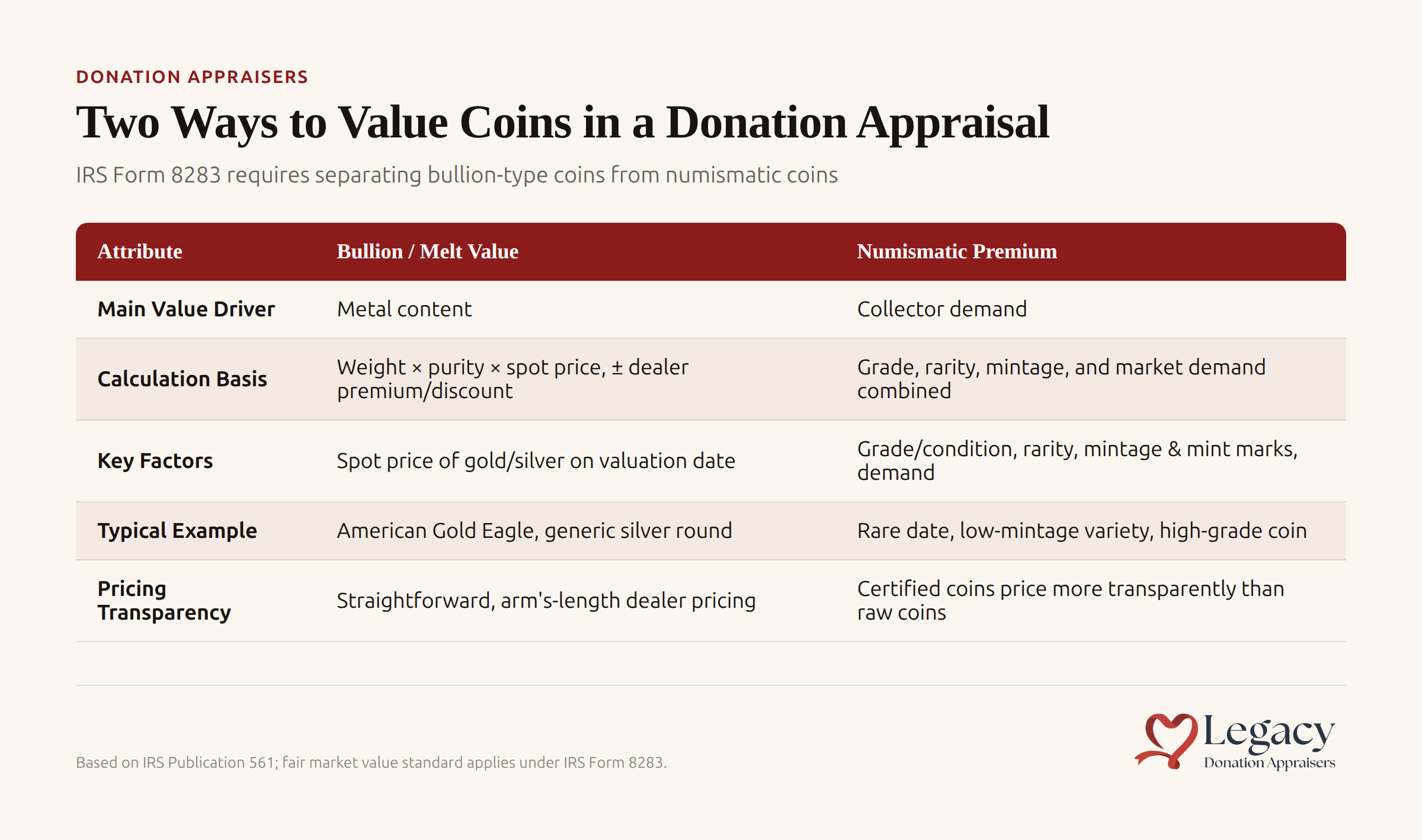
Coin value for donation purposes comes from fair market value, defined by the IRS as the price a willing buyer and willing seller would agree on, with neither under pressure to act and both aware of the relevant facts, as described in Publication 561. For gold and silver coins, arriving at that number means weighing two very different value drivers, often within the same collection.
Bullion or melt value applies to coins and bars whose worth is driven mainly by metal content. The calculation is straightforward: weight and purity multiplied by the spot price of gold or silver on the valuation date, adjusted for the modest premium or discount typical in arm's-length dealer transactions. A common American Gold Eagle or a generic silver round usually falls into this category.
Numismatic premium applies when collector demand, not metal content, drives the price. A rare date, a low-mintage variety, or a coin in exceptional condition can be worth many times its melt value. Determining that premium requires looking at:
- Grade and condition: Assessed against standard numismatic grading scales, with certified coins (graded and encapsulated by a recognized third-party service) generally carrying more transparent, verifiable market pricing than raw, ungraded coins.
- Rarity and survival estimates: How many examples of that date, mint, and grade are believed to still exist, not just how many were originally struck.
- Mintage figures and mint marks: Original production numbers by mint facility, since the same date struck at two different mints can carry very different values.
- Market demand: Whether the series has an active collector base, reflected in recent auction results and dealer bid and ask levels.
A competent appraisal doesn't default to one method for the whole collection. It separates bullion-type coins, valued primarily on melt, from numismatic coins, valued on collector demand, and documents the methodology for each. Sentimental value, family history, or how long the coins have been held has no bearing on fair market value, even though it often matters to the donor personally.
What Documentation to Gather Before Your Appraisal
Having your records organized before the appraiser's examination speeds up the process and strengthens the final report. Gather what you have, even if the file is incomplete; an appraiser can work around gaps, but a fuller record makes for a more precise valuation.
Before your appraisal, try to collect the following:
- Purchase records or receipts showing when and where the coins were acquired, and at what price, if you bought them yourself.
- Provenance documentation if the coins were inherited, including any estate inventory, prior estate appraisal, or family correspondence describing the collection's history.
- Prior appraisals or insurance schedules, even outdated ones, which help establish a valuation baseline and show the collection hasn't been altered.
- Grading certificates for any coins that have already been certified by a third-party grading service, including the certification number.
- A basic inventory list describing each coin: denomination, date, mint mark, and approximate condition, to the extent you can identify them.
- Photographs of individual coins or groups, particularly for anything you believe may be rare or especially valuable.
None of this is required to get an appraisal started, but each item you can supply narrows the amount of independent research the appraiser has to do and helps confirm details like acquisition date, which the IRS requires on Form 8283.
How the Appraisal Process Works
An appraisal for a coin donation follows a defined sequence, whether the collection has a dozen coins or several hundred.
- Intake and scoping. You describe the collection, its approximate size, and your intended donation timeline. This determines whether the engagement is scoped as a standard or IRS-qualified appraisal.
- Examination and grading review. The appraiser physically examines the coins, or reviews existing third-party grading certifications, noting condition, wear, and any damage or alterations that affect value.
- Market research. The appraiser pulls current spot metal prices for bullion-type coins and recent auction results, dealer transactions, and price guide data for numismatic pieces, matching comparables by date, mint, and grade wherever possible.
- Valuation and reconciliation. Each coin or lot is assigned a fair market value, with bullion and numismatic methodologies applied separately and documented, then totaled for the collection.
- Report preparation. The appraiser prepares a written report in accordance with USPAP (the Uniform Standards of Professional Appraisal Practice, published by The Appraisal Foundation), including the inventory, methodology, and market data supporting each value.
- Form 8283 completion. For collections claimed over $5,000, the appraiser completes and signs Section B, Part III of Form 8283, the appraiser declaration, which you then take to your tax preparer along with the rest of the completed form.
Our appraisers hold credentials with organizations including the ASA, ISA, AAA, and CAGA, and every coin appraisal is prepared in accordance with USPAP and structured to meet the documentation requirements in the IRS Form 8283 instructions and Publication 561. We don't promise IRS acceptance since that determination belongs to the IRS, but we build every report to the standard it expects to see.
What a Qualified Appraiser Looks Like
Under IRS Notice 2006-96, a qualified appraiser must hold an appraisal designation or otherwise meet minimum education and experience requirements, perform appraisals regularly as part of their business, and demonstrate verifiable experience valuing the specific type of property involved, in this case, coins and bullion. The appraiser also can't be the donor, the donee organization, or anyone with a disqualifying financial relationship to the transaction.
What to Expect in Your Final Appraisal Report
A completed coin appraisal report should read as a self-contained document that stands on its own if the IRS ever asks to see it. At minimum, expect it to include a full property description (coin type, metal, dates, mint marks, quantities, and certification numbers where applicable), a statement of physical condition and grade, the appraiser's qualifications, the valuation method used for each coin or lot, the market data supporting those figures, and the appraised fair market value as of the contribution date. The report will also carry the appraiser's signature, the date of the appraisal (dated no earlier than 60 days before the contribution), and, for donations over $5,000, a signed Section B, Part III on Form 8283 ready to submit with your return.
What a Coin Appraisal for Donation Costs
Fees for a coin appraisal are quoted as a fixed amount before work begins, scoped to the size and complexity of the collection rather than billed hourly. Standard reports typically start at $195, with IRS-qualified appraisals for donations over $5,000 starting at $295. Most coin collection appraisals for donation purposes run between $595 and $2,200, and larger or more complex collections involving rare, high-grade, or extensively researched numismatic material can run from $1,500 to $6,000 or more. The driver is scope: how many coins are involved, how much research each requires, and whether the intended use calls for a standard or IRS-qualified report, not the dollar value of the coins themselves.
If you're getting ready to donate a gold or silver coin collection, our coin appraisal service for charitable donation can scope the assignment and walk you through exactly what's needed before you request an appraisal.
This article is provided for general informational purposes only and does not constitute legal, tax, or financial advice. Readers should consult a qualified attorney or CPA regarding their specific circumstances.