
Blog
Insurance Value vs Fair Market Value for Donations: Why the IRS Only Accepts One
Insurance value, replacement cost, and fair market value can produce three very different numbers for the same donated item, and only one of them supports an IRS charitable deduction. This guide walks through a worked example so you know which figure actually belongs on Form 8283.
A donor who hands a tax preparer their homeowner's insurance rider for a diamond ring, expecting it to double as proof of a charitable deduction, is usually in for a surprise. Insurance value, replacement cost, and fair market value are three distinct numbers, and the IRS recognizes only one of them for a noncash charitable contribution. This matters because the gap between what an item is insured for and what it would actually sell for can be enormous, and using the wrong figure risks a denied or reduced deduction. Before donating anything of meaningful value, it helps to understand how these three figures are calculated and why the IRS insists on the one that reflects an actual market transaction. For higher-value personal property, our personal property appraisal service is built specifically to produce the fair market value documentation the IRS expects.
What Is Fair Market Value, and Why Does the IRS Require It?
Fair market value is the price property would change hands for between a willing buyer and a willing seller, with neither party under compulsion to act and both having reasonable knowledge of the relevant facts, as defined in Treasury Regulation 1.170A-1(c)(2). That definition is deliberately transactional. It asks what the item would actually sell for in an appropriate market, not what it would cost to replace or what an insurer agreed to cover it for.
For donations valued above $5,000, this isn't a figure a donor can simply estimate. The IRS generally requires a qualified appraisal prepared by a qualified appraiser, with the result reported on Form 8283, Section B (see our guide on the Form 8283 threshold rules for the exact dollar breakpoints). Below that threshold, a donor has more latitude to document value directly, but the standard being documented is still fair market value, never an insurance figure.
Insurance Value, Replacement Cost, and Fair Market Value Compared
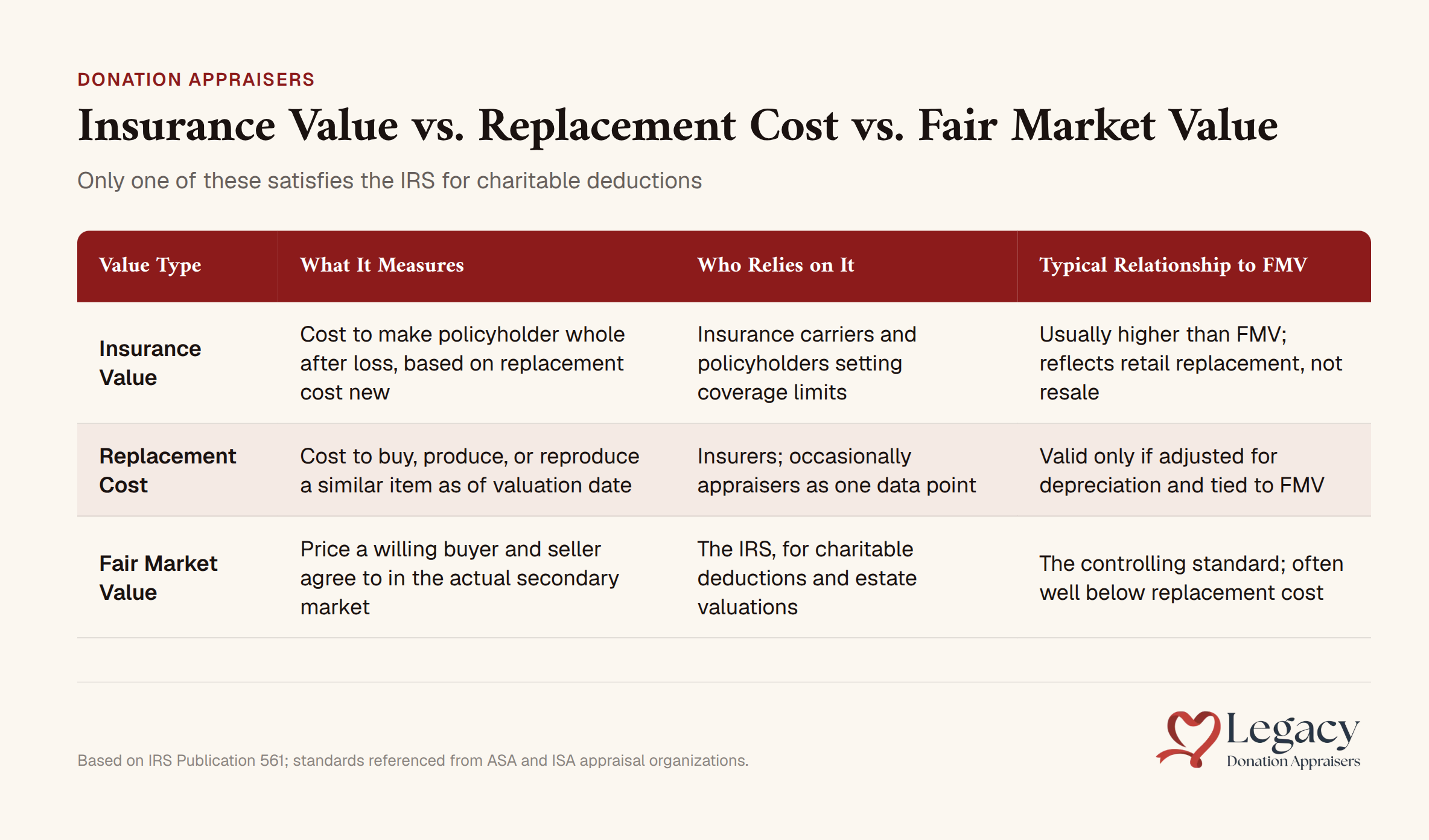
Each of these three figures answers a different question, and confusing them is one of the most common reasons a charitable deduction gets challenged. IRS Publication 561 specifically warns that replacement cost, and by extension most insurance valuations, usually bears no direct relationship to fair market value.
| Value Type | What It Measures | Who Relies on It | Typical Relationship to FMV |
|---|---|---|---|
| Insurance Value | What it would cost to make the policyholder whole after a covered loss, often based on replacement cost new | Insurance carriers and policyholders setting coverage limits | Usually higher than FMV; reflects retail replacement, not resale |
| Replacement Cost | The cost to buy, produce, or reproduce a similar item as of the valuation date | Insurers, and occasionally appraisers as one data point among several | Can be considered only if adjusted for depreciation and reasonably related to FMV |
| Fair Market Value | The price a willing buyer and willing seller would agree to in the item's actual secondary market | The IRS, for charitable deductions and estate valuations | The controlling standard; often well below replacement cost |
Our appraisers, drawing on standards recognized by organizations such as the ASA and ISA, routinely see donors arrive with an insurance appraisal in hand, assuming it will satisfy the IRS. It won't, because it was never built to answer the question the tax code asks.
A Worked Example: One Diamond Ring, Three Dollar Figures
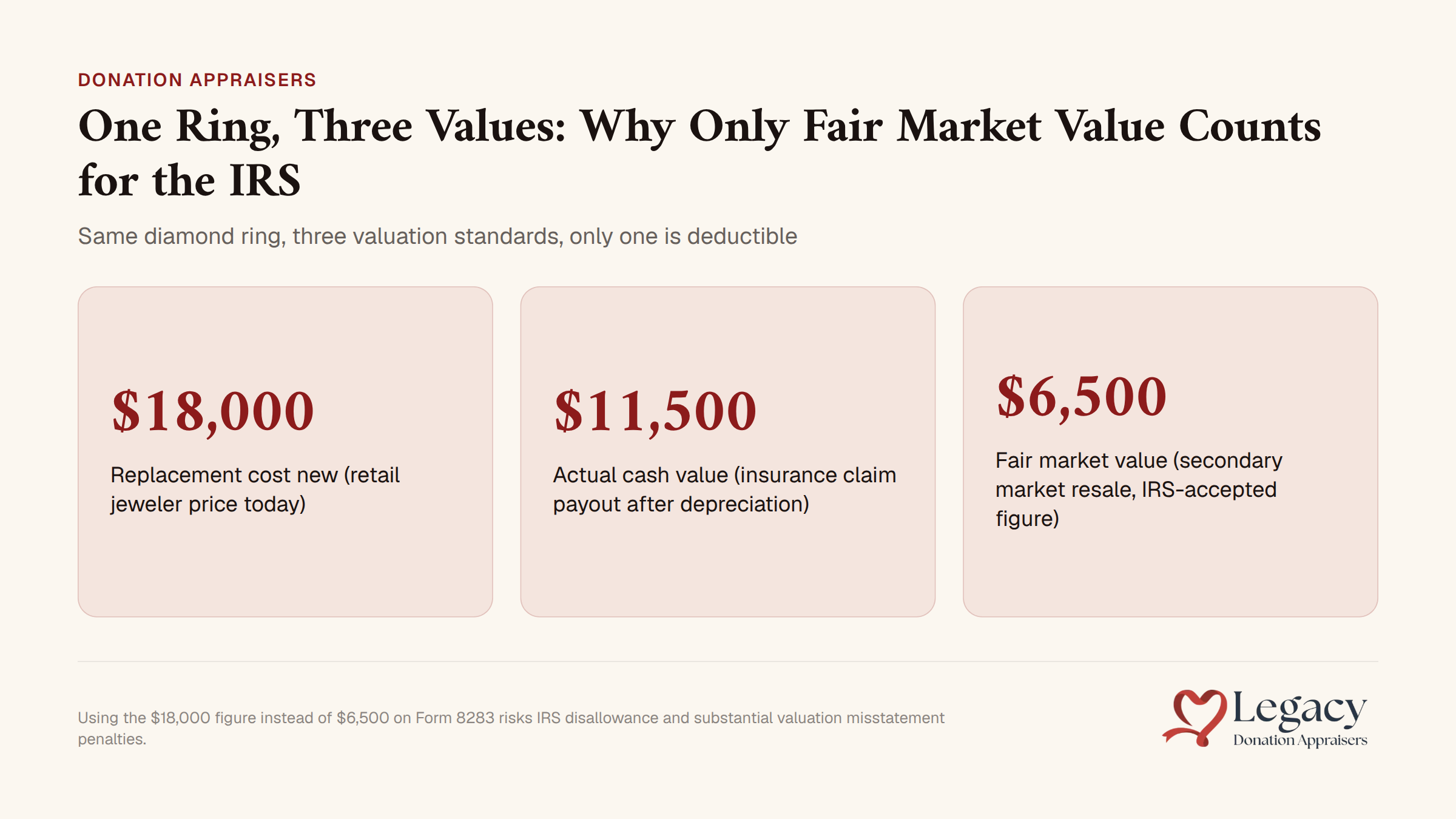
Consider a diamond engagement ring that a donor wants to give to a qualified charitable organization. The same physical object produces three very different numbers depending on which standard is applied.
- Replacement cost new: $18,000. This is what a retail jeweler would charge today to sell an equivalent new ring, and it's the figure most insurance policies use to set coverage limits.
- Actual cash value (the insurance claim basis): $11,500. Insurers calculate this by taking replacement cost new and subtracting depreciation for age, wear, and style changes; it's the number a policyholder would actually be paid if the ring were lost or stolen.
- Fair market value: $6,500. This reflects what the ring would realistically sell for in its actual secondary market, such as through an estate jewelry dealer or auction house, where buyers pay well below retail for a used piece.
Example: If this donor claims the $18,000 insurance replacement figure on Form 8283 instead of the $6,500 fair market value supported by comparable sales, the IRS can disallow nearly two-thirds of the deduction on examination, along with potential penalties for a substantial valuation misstatement.
Key takeaway: The dollar figure that belongs on a donor's tax return is always the one a buyer would actually pay, not the one an insurer would pay out or a jeweler would charge for something new.
Why Publication 561 Singles Out Insurance Appraisals
IRS Publication 561 addresses jewelry and furs directly because these are exactly the categories where insurance value and fair market value diverge most dramatically. An insurance appraisal for a fur coat or a diamond ring is typically built around retail replacement cost, since the insurer's job is to make the policyholder whole with a comparable new item, not to estimate resale value.
A used fur coat or ring, by contrast, often has a thin resale market and sells for a fraction of what a new equivalent costs. The IRS has consistently held, in guidance and in court decisions involving similar used-property donations, that the only market available to a donor is the actual resale market for that type of item, not the retail market for a new replacement. An appraiser determining fair market value has to research what comparable used items actually sold for, not what a jeweler charges for inventory on a showroom floor.
Watch out: An insurance rider, a jeweler's retail quote, or a replacement-cost estimate from a homeowner's policy is not a substitute for a qualified appraisal. Submitting one of these documents in place of a proper fair market value appraisal is one of the most common reasons a noncash deduction gets reduced or denied on examination.
The $5,000 Threshold and the 60-Day Appraisal Window
A qualified appraisal is generally required once a donated item or group of similar items is valued above $5,000, and the appraisal must be reported on Form 8283, Section B. IRS Publication 561 also sets a timing rule: the appraisal must be prepared no earlier than 60 days before the date the item is actually donated, and it must be completed before the tax return claiming the deduction is due.
This timing rule exists because fair market value is tied to the market conditions on the date of the gift, not some earlier or later date. An appraisal commissioned a year before the donation, or one that was originally prepared for insurance purposes months earlier, generally will not satisfy the 60-day window even if the dollar figure happens to be close.
Pro tip: If you're unsure whether your donation will clear $5,000 once grouped with similar items you're giving the same year, our guide on the qualified appraiser requirements under IRS rules walks through how the aggregation rule works and who is eligible to sign the appraisal.
What Happens When You Submit the Wrong Document
Donors sometimes assume any professional-looking appraisal will satisfy the IRS, but the agency and the courts look closely at both the valuation method used and the market the appraiser selected. An appraisal built on replacement cost, retail quotes, or an insurer's depreciation schedule, rather than actual comparable sales in the item's resale market, does not meet the fair market value standard even if it was prepared by a credentialed professional.
The consequences of using the wrong figure can include a reduced deduction, a denied deduction, interest on the underpayment, and in cases of substantial overstatement, accuracy-related penalties. The IRS's own guidance on valuing noncash contributions makes clear that the burden of establishing fair market value rests with the donor, which means the appraisal document itself has to hold up to that standard, not just carry a professional letterhead.
A qualified appraisal prepared for IRS purposes will typically document the comparable sales considered, explain any adjustments for condition or market differences, and state plainly that the conclusion reflects fair market value as defined under the tax code, not replacement or insurance value. That distinction, spelled out clearly in the report itself, is often what separates a deduction that survives examination from one that doesn't.
Getting the right figure on Form 8283 starts with getting the right kind of appraisal from the outset. If you're preparing to donate jewelry, furs, art, or other personal property and want a report built around the standard the IRS actually applies, request an appraisal from our team before you file.
This article is provided for general informational purposes only and does not constitute legal, tax, or financial advice. Readers should consult a qualified attorney or CPA regarding their specific circumstances.