
Blog
IRS Price List for Donated Items: Why There Isn't One and What to Use Instead
The IRS publishes no price list for donated items: the deduction is each item's fair market value, which for used clothing and household goods means thrift shop prices. This guide shows how to set that value, where charity value guides fit, and which donations need more than a list.
Published
Key Takeaways on the IRS Price List for Donated Items
Here is what donors need to know before they put a value on donated items for a tax deduction:
- No IRS price list exists: The IRS does not publish a price list for donated items. IRS Publication 561 says clothing valuation "does not lend itself to fixed formulas or methods" and points donors to what buyers pay in thrift and consignment shops.
- Charity value guides are estimates, not IRS figures: The donation value guides that charities such as The Salvation Army publish give low and high ranges for common items. The donor still chooses the value and is responsible for it.
- Condition decides whether an item counts: Used clothing and household items must be in good used condition or better to be deductible. A single item below that standard qualifies only when it is claimed at more than $500 and backed by a qualified appraisal.
- Records grow with the deduction: A noncash gift over $500 goes on Form 8283, and a deduction over $5,000 for an item or a group of similar items requires a qualified appraisal, such as a personal property appraisal for charitable donation.
The IRS does not publish a price list for donated items. The deduction for donated clothing, furniture and household goods is each item's fair market value on the day of the gift, and the donor sets that value and must support it. This guide explains how the IRS expects that value to be found, how to use a charity's value guide correctly, and which donations need a qualified appraisal instead of a list.
Does the IRS Publish a Price List for Donated Items?
The IRS does not publish a price list, chart or schedule of values for donated items. IRS Publication 561, Determining the Value of Donated Property, sets out valuation principles instead of prices, and it says so directly for clothing:
"Valuation of items of clothing does not lend itself to fixed formulas or methods. The price that buyers of used items actually pay in used clothing stores, such as consignment or thrift shops, is an indication of the value." - IRS Publication 561, Used Clothing
Fair market value is the standard behind that guidance. Publication 561 defines it as "the price that property would sell for on the open market," agreed on between a willing buyer and a willing seller who both know the relevant facts and neither of whom has to act. For a used sweater or a 10-year-old sofa, that open market is the resale shop, not the store where the item was bought new.
The original purchase price does not set the deduction. Publication 561 notes that the fair market value of used household items "is usually much lower than the price paid when new," and that out-of-style items can have little or no market value at all.
How the IRS Expects You to Value Donated Clothing and Household Items
Thrift shop value is the method the IRS itself names for these items. The Instructions for Form 8283 list "Thrift shop value" (for clothing or household items) as an example entry for the column where donors state how they determined fair market value. The same instructions add that classified ads, in print or online, show what similar products sell for.
Household items, in the IRS definition, cover furniture, furnishings, electronics, appliances, linens and similar items. Paintings, antiques, objects of art, jewelry, gems and collections such as stamps and coins fall outside that category, and Publication 561 sends property that is valuable because it is old or unique to its separate art and collectibles rules.
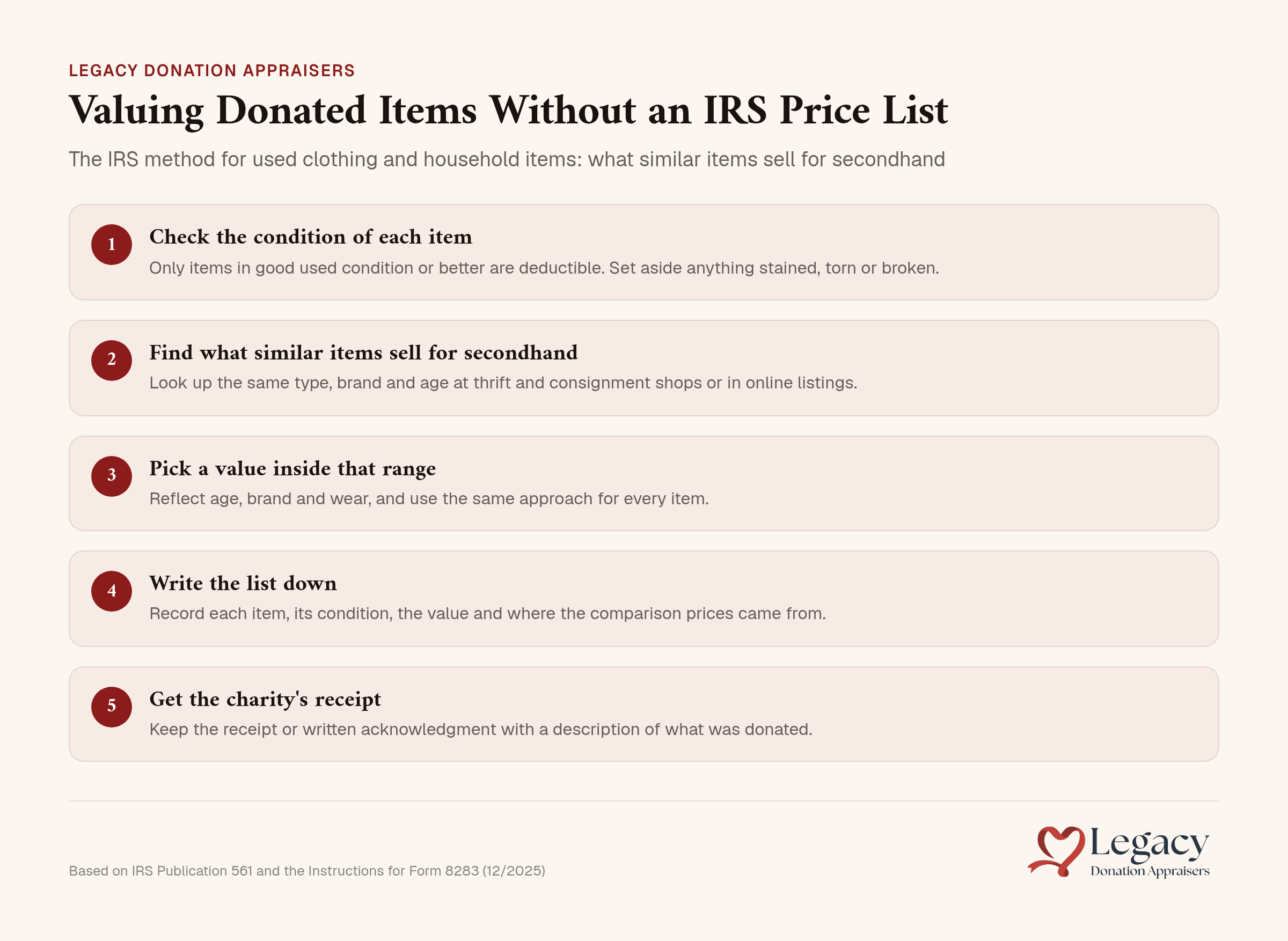
The process for valuing a bag or a truckload of everyday donated items without a price list follows 5 steps:
- Check the Condition of Each Item
- Clothing and household items must be in good used condition or better to be deductible, so set aside anything stained, torn, broken or missing parts.
- Find What Similar Items Sell for Secondhand
- Look up prices for the same type, brand and age of item at local thrift and consignment shops or in online listings.
- Pick a Value Inside That Range
- Choose a figure that reflects the item's age, brand and wear, and apply the same approach to every item on the list.
- Write the List Down
- Record each item, its condition, the value and where the comparison prices came from.
- Get the Charity's Receipt
- Keep the receipt or written acknowledgment the charity provides at drop-off, with a description of what was donated.
Example: A donor drops off 3 men's jackets, a coffeemaker and a working refrigerator. Using thrift-shop prices for comparable items, the donor values the jackets at $15 each, the coffeemaker at $10 and the refrigerator at $180, for a total of $235. That gift stays under $250, so a receipt from the charity is the required record, and the donor's item list with its price sources supports the figures.
Watch out: The price tag from the original purchase is not the deduction. A coat bought for $300 4 years ago is worth what a similar used coat sells for today.
Charity Donation Value Guides: The Closest Thing to an IRS Price List
A charity donation value guide is the closest thing to the price list most donors are looking for. The Salvation Army's Donation Value Guide lists low and high estimates for commonly donated items and asks donors to "choose a value within this range that reflects your item's relative age and quality." Other charities publish their own versions.
The Salvation Army's guide is clear about whose number the value is: "The Salvation Army does not set a valuation on your donation. It's up to you to assign a value to your item." A value guide is a starting point for comparable prices, not an IRS-approved figure, and the donor carries the responsibility for the number on the return.
The ranges below come from The Salvation Army's guide as published in November 2026, and they show how wide a single line can be:
| Item | Low | High |
|---|---|---|
| Men's jacket | $8 | $26 |
| Coffeemaker | $4 | $16 |
| Sofa | $36 | $207 |
| Refrigerator (working) | $78 | $259 |
A range that wide is why condition and age matter. A sofa near the top of its range is clean, current and sound. A sofa with worn upholstery belongs near the bottom, or out of the deduction entirely once it no longer meets the good used condition standard.
Donation tracking apps fill the same role for donors who give often. Several of them suggest values item by item and export a year-end summary, and our review of ItsDeductible alternatives compares them. Every one of those tools works from the same thrift-market principle, and none of them replaces a qualified appraisal when the IRS requires one.
Pro tip: Save or screenshot the comparison prices on the day you value the items. Prices on resale sites change, and a saved page shows how each value was set.
Donated Items a Price List Cannot Value
A price list stops working in 3 situations: the item is not in good used condition, the item is valuable because it is old or unique, or the deduction crosses $5,000.
Items below good used condition. A single item of clothing or a household item that is not in good used condition or better is deductible only when the donor claims more than $500 for it and supports that value with a qualified appraisal and Form 8283, Section B. Both go in with the return.
Antiques, art, jewelry and collections. Publication 561 leaves these out of household items. Their fair market value comes from sales of comparable property in the market for that type of item, not from thrift-shop pricing, and a deduction over $5,000 for them requires a qualified appraisal.
Deductions over $5,000. A claimed deduction over $5,000 for an item or a group of similar items requires a qualified appraisal signed and dated by a qualified appraiser, plus Form 8283, Section B. The IRS counts similar items together across every charity that received them, and furniture, clothing and household goods are each a category of similar items. Publication 561 gives the example of books donated to 3 schools and deducted at $2,000, $2,500 and $900: the $5,400 total requires a qualified appraisal even though no single gift crossed $5,000.
Example: A family donates the furniture from a parent's home to 2 charities in the same year, claiming $3,200 at one and $2,400 at the other. The $5,600 furniture total crosses $5,000, so the family needs a qualified appraisal and a Form 8283, Section B, for each charity.
Records the IRS Requires for Donated Items at Each Dollar Level
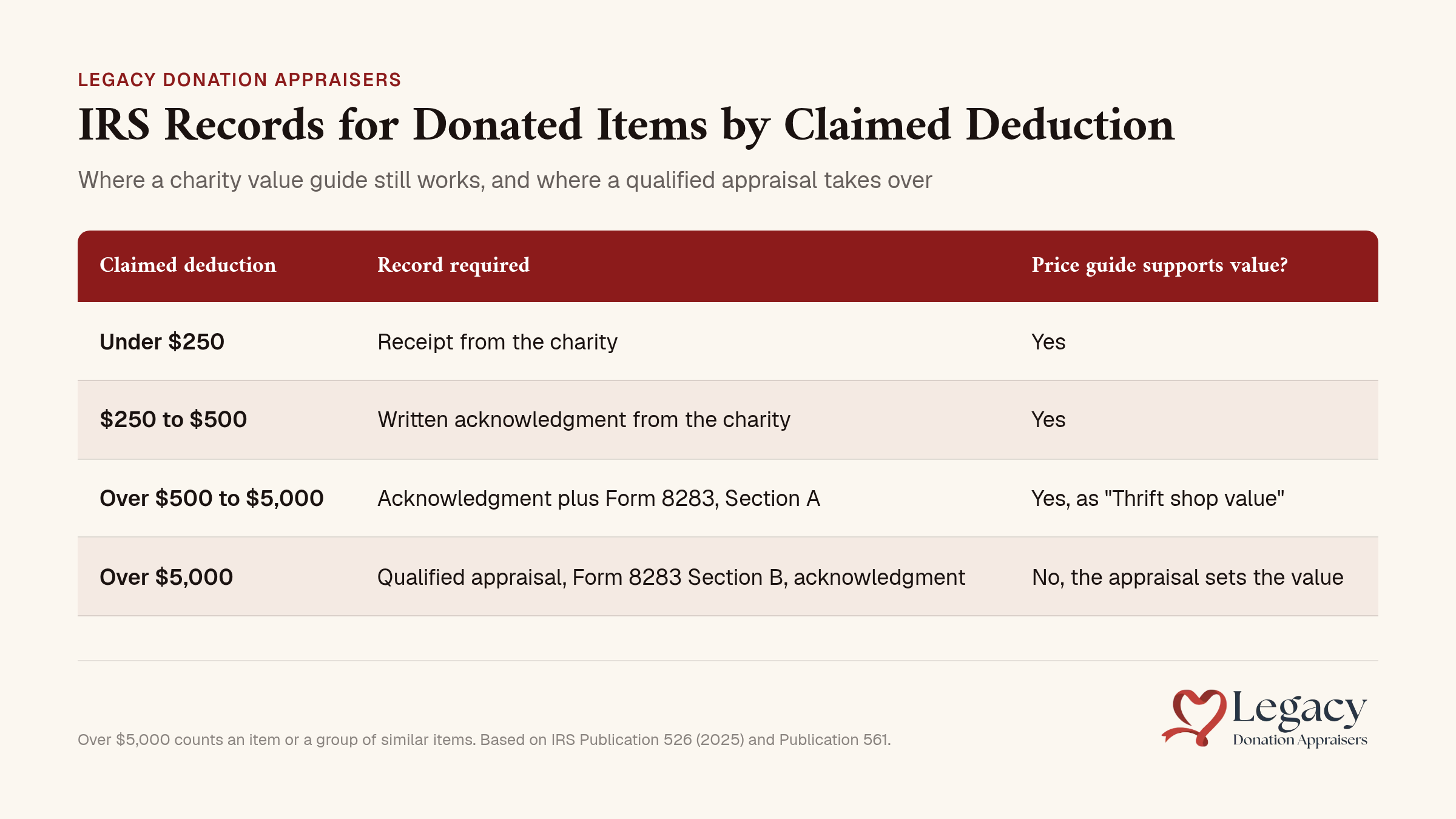
The record a donor needs grows with the claimed deduction. IRS Publication 526 sets these tiers for noncash gifts, and the table shows where a value guide still works:
| Claimed deduction | Record required | Can a price guide support the value? |
|---|---|---|
| Under $250 | Receipt from the charity with its name and address, the date and location, and a description of the item | Yes |
| $250 to $500 | Written acknowledgment from the charity, received by the time you file | Yes |
| Over $500 to $5,000 | Written acknowledgment plus Form 8283, Section A, with the value and the method used | Yes, entered as "Thrift shop value" for clothing and household items |
| Over $5,000 (item or group of similar items) | Qualified appraisal, Form 8283, Section B, and the written acknowledgment | No, a qualified appraisal sets the value |
Form 8283 is a summary, not a valuation. The Form 8283 instructions say so plainly: "Form 8283 is an appraisal summary. It is not an appraisal." A completed form with a value pulled from a guide does not satisfy the qualified appraisal requirement above $5,000.
Donated Items and the 2026 Deduction Rules
Donated items still require itemizing. Beginning with tax year 2026, taxpayers who do not itemize can deduct up to $1,000 of cash gifts to qualifying charities, or $2,000 for married couples filing jointly, but the IRS announcement of the new deduction states that "Noncash contributions do not qualify." A deduction for donated clothing, furniture or household goods stays on Schedule A, and the valuation and record rules above apply in full.
Protect Your Deduction for Donated Items Worth More Than a List
Legacy Donation Appraisers prepares qualified appraisals for the donations a price list cannot support: furniture and household contents over $5,000, antiques, art, jewelry and collections, and single items claimed above $500 that fall below good used condition. Our appraisers hold credentials with leading organizations such as the ASA, ISA and AAA, and every report is prepared in accordance with USPAP and the IRS requirements for Form 8283. Request a donation appraisal for a fixed-fee quote before you file.
This article is provided for general informational purposes only and does not constitute legal, tax, or financial advice. Readers should consult a qualified attorney or CPA regarding their specific circumstances.