
Blog
Understanding the Related-Use Rule for Charitable Donations Sold at Auction
The related-use rule caps your charitable deduction at cost basis, not fair market value, whenever a charity sells your donated item instead of using it in its mission. This guide walks through the IRS test, the three-year recapture rule, and worked examples for art, collectibles, and equipment donations.
Donors who give appreciated art, collectibles, or equipment to charity often assume they can deduct the full fair market value. That assumption breaks down the moment the charity turns around and sells the item, especially at a benefit auction or fundraising gala. The related-use rule under IRC Section 170(e)(1)(B)(i) can quietly cut a deduction from a six-figure fair market value down to a five-figure cost basis, and most donors never see it coming until their tax preparer asks the wrong question at the wrong time.
This guide explains what counts as related use versus unrelated use, walks through the practical trap of charity auctions, and works through real numbers for art, a collectible auction lot, and donated equipment. It also covers the three-year disposition rule and the donee's Form 8282 filing obligation, since what happens after you donate can retroactively affect your deduction.
What Is the Related-Use Rule Under IRC Section 170(e)(1)(B)(i)?
The related-use rule limits a donor's deduction for appreciated tangible personal property to cost basis, not fair market value, whenever the receiving charity puts the property to a use that is unrelated to its exempt purpose. Treasury Regulation 1.170A-4 is the regulatory framework behind this limitation, and it applies specifically to capital gain property such as art, coins, antiques, and equipment held longer than one year.
The IRS is direct about how sales factor into this test. As the IRS charity auctions guidance explains, "the sale of an item is considered unrelated, even if the sale raises money for the charity to use in its programs." In other words, it does not matter how worthy the cause is or how the proceeds get spent. What matters is whether the specific item you donated was used in a way connected to the charity's mission, or simply converted to cash.
Under IRS Publication 526, a donor of capital gain property can generally deduct fair market value, but that deduction must be reduced to basis when the unrelated-use exception applies. This is the mechanism that turns a generous-looking gift into a much smaller write-off.
Related Use vs. Unrelated Use: The Museum Painting Example
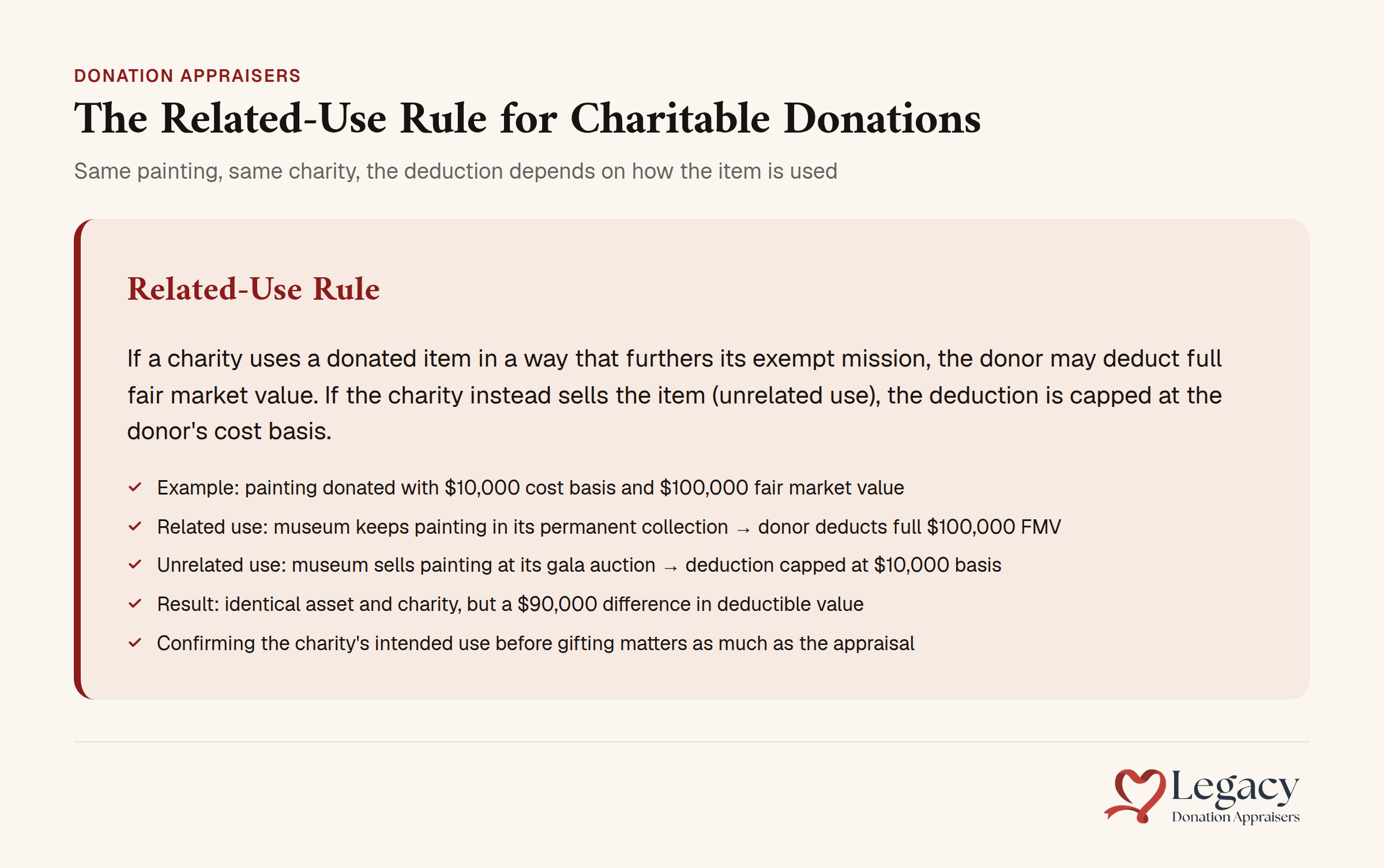
A museum that adds a donated painting to its permanent collection, or loans it for exhibition, is putting the painting to related use. A museum that accepts the same painting and immediately consigns it to its annual fundraising gala auction is putting it to unrelated use, because the museum's exempt function is curating and exhibiting art, not running an auction house.
Example: A donor gives a painting with a $10,000 cost basis and a $100,000 appraised fair market value to a museum.
- Scenario A, related use: The museum accessions the painting into its permanent collection. The donor may deduct the full $100,000 fair market value (subject to standard adjusted gross income percentage limits).
- Scenario B, unrelated use: The museum instead sells the painting at its spring gala auction to raise operating cash. The donor's deduction is capped at the $10,000 cost basis, a loss of $90,000 in deductible value.
The asset, the appraisal, and the charity are identical in both scenarios. Only the charity's use of the item changes the outcome. Our fine art appraisal service for charitable donations routinely fields questions from donors who discovered this rule only after the fact, which is why confirming intended use before the gift matters as much as the appraisal itself.
Why Charity Galas and Benefit Auctions Are a Common Trap
Benefit auctions are, by design, built to turn donated items into cash for the charity's general operations. That structure is precisely what the related-use rule penalizes. A donor who hands a piece of jewelry, a signed guitar, or a vacation package to a gala committee is almost always triggering unrelated use, because the entire point of the donation is resale to the highest bidder.
Most donors never ask the charity how the item will be handled. They see the tax-deductible line on the gala invitation and assume full fair market value applies. It rarely does for appreciated tangible property sold at auction.
Worked Example: A Coin Collection Donated for a Gala Auction
Example: A donor contributes a set of graded coins with a $1,500 cost basis and a $6,000 appraised fair market value to a nonprofit's annual gala. The nonprofit auctions the coins that same evening for $5,800.
Because the coins were sold rather than retained or used in the charity's programs, this is unrelated use. The donor's deduction is limited to the $1,500 cost basis, not the $6,000 fair market value the coins actually commanded at auction. The donor claimed the appraisal thinking the deduction would exceed the $5,000 threshold that triggers a qualified appraisal requirement, but since the allowed deduction dropped to $1,500, the appraisal turned out to document a value the donor could not actually claim.
This is a common and expensive surprise. Anyone donating coins, memorabilia, or collectibles for a benefit auction should treat the related-use question as more important than the appraisal number itself, since it determines which number actually reaches the tax return. Our coin appraisal service for charitable donations always asks about the intended disposition of the item before the engagement begins, precisely to flag this issue early.
Equipment Donations: Daily Use vs. Immediate Resale
The related-use rule is not limited to art and collectibles. Donated machinery and equipment follow the identical test, and the practical stakes can be even larger given the dollar values involved.
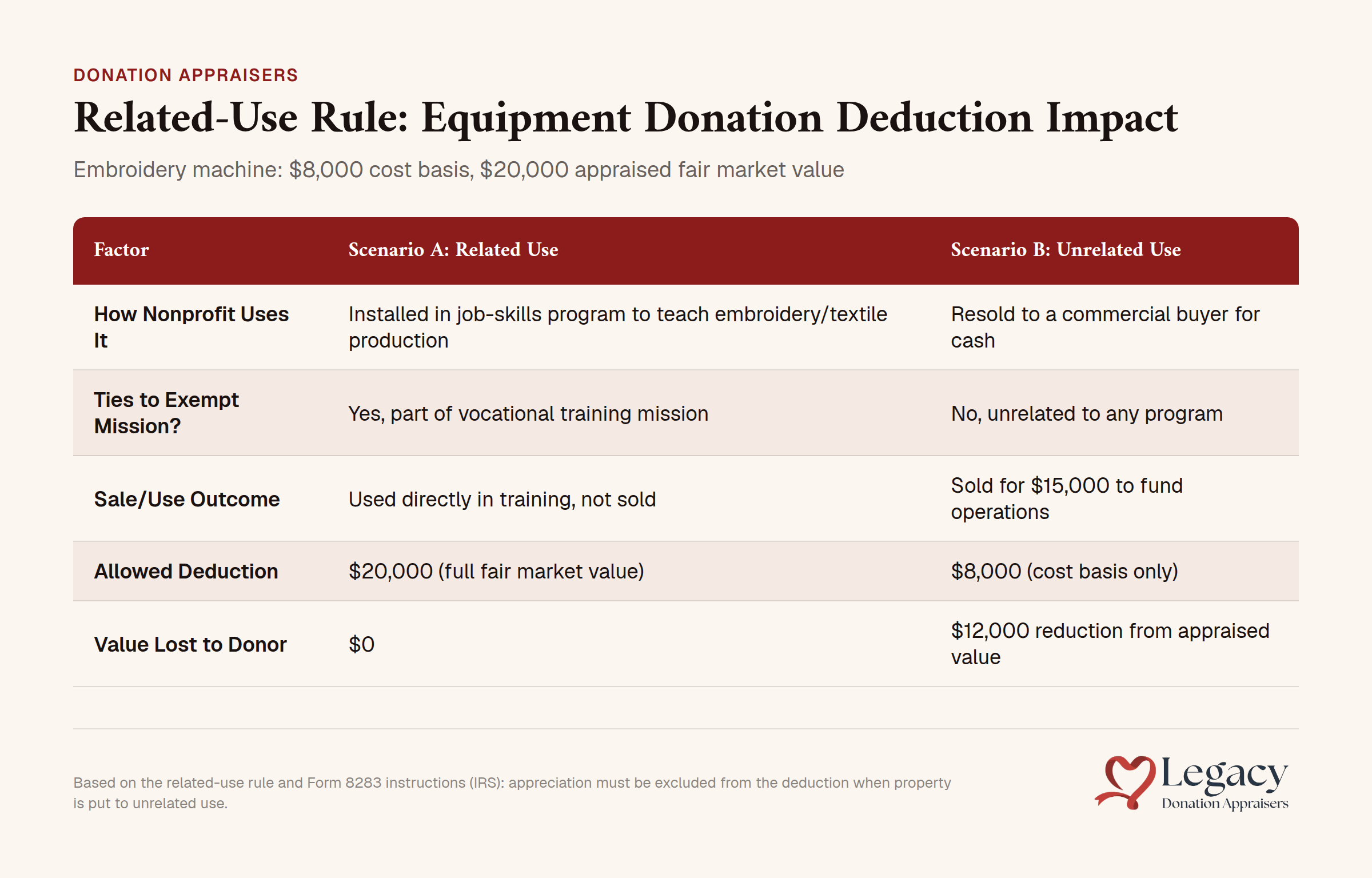
Example: A business donates a commercial embroidery machine with an $8,000 cost basis and a $20,000 appraised fair market value to a nonprofit vocational training center.
- Scenario A, related use: The training center installs the machine in its job-skills program and uses it to teach students embroidery and textile production, which is part of its exempt educational mission. The donor deducts the full $20,000 fair market value.
- Scenario B, unrelated use: The same nonprofit has no vocational program and simply resells the machine to a commercial buyer for $15,000 to fund general operations. The donor's deduction is limited to the $8,000 cost basis, a $12,000 reduction from the appraised value.
Capital gain property under the Form 8283 instructions generally allows a fair market value deduction, but the instructions confirm that appreciation must be excluded from the deduction whenever the property is put to unrelated use. Equipment donors should confirm in writing how a nonprofit intends to use the asset before signing over title, not after. Our machinery and equipment appraisal service for charitable donations works with donors on exactly this kind of pre-donation planning.
The Three-Year Rule and Form 8282: What Happens After You Donate
Even a gift that starts out as related use is not permanently safe. IRC Section 170(e)(7) adds a disposition rule for certain donations of tangible personal property where the donor claimed a deduction over $5,000. If the charity disposes of that property within three years of receiving it, and the disposition is inconsistent with the related use the donor relied on, the donor may have to recapture the difference between the claimed fair market value and the cost basis as ordinary income in the year the charity disposes of the item.
Charities are not free to sell the item quietly, either. Once a donee organization disposes of covered property within three years of the contribution, it generally must file Form 8282 with the IRS to report the disposition, which the IRS can then match against the donor's original deduction. This creates a paper trail that connects the charity's later decisions directly back to the donor's tax return, sometimes years after the original gift.
Watch out: A charity that promises to display your donated art "for now" and then quietly sells it eighteen months later during a budget shortfall can trigger recapture on a deduction you already claimed. Get the charity's intended use, and its plans for the item over the following three years, in writing before you donate.
How to Protect Your Deduction Before You Donate
The single most effective safeguard is asking the charity directly, before the gift is finalized, how the item will be used or disposed of. A charity that plans to exhibit, use, or retain the property in connection with its exempt function supports a full fair market value deduction. A charity that plans to sell, auction, or liquidate the item does not, regardless of how the proceeds will be spent.
The following table summarizes how the three scenarios above play out side by side:
| Asset | Cost Basis | Fair Market Value | Charity's Use | Allowed Deduction |
|---|---|---|---|---|
| Painting | $10,000 | $100,000 | Added to permanent collection (related) | $100,000 |
| Painting | $10,000 | $100,000 | Sold at gala auction (unrelated) | $10,000 |
| Coin set | $1,500 | $6,000 | Sold at gala auction (unrelated) | $1,500 |
| Embroidery machine | $8,000 | $20,000 | Used in job-training program (related) | $20,000 |
| Embroidery machine | $8,000 | $20,000 | Resold for operating cash (unrelated) | $8,000 |
Key takeaway: The appraisal establishes fair market value, but the charity's actual use of the item determines whether you can deduct that value or only your cost basis. Get the intended use in writing, keep documentation of your original purchase price, and revisit the question if the charity's plans change within three years of your gift.
A qualified appraisal remains necessary whenever you intend to claim a deduction over $5,000 for related-use property, and it documents the value the IRS and the charity's own Form 8283 reporting will reference. But no appraisal can rescue a deduction once the related-use rule caps it at basis. That determination happens on the ground, in the charity's warehouse or auction catalog, not in the appraisal report.
If you are planning a significant gift of art, collectibles, or equipment and want to understand which deduction rule will apply, our personal property appraisal services for charitable donations can help you scope the valuation and flag related-use risk before you sign anything over.
This article is provided for general informational purposes only and does not constitute legal, tax, or financial advice. Readers should consult a qualified attorney or CPA regarding their specific circumstances.