
Blog
RV and Trailer Appraisal for Charitable Donation: What IRS Form 8283 Requires
Donating a motorhome or travel trailer to charity can trigger IRS Form 8283's qualified appraisal requirement once the claimed deduction tops $5,000. This guide walks through the special "qualified vehicle" rule, what actually drives fair market value, and how the appraisal process works for this asset type.
Donating a recreational vehicle or trailer to a qualifying charity can produce a meaningful tax deduction, but the IRS treats this asset class with more nuance than most donors expect. Whether you need a qualified appraisal, and whether your deduction is capped at resale proceeds or based on full fair market value, depends on one key distinction: is the unit motorized or towable? This guide walks through the donation process, the $5,000 appraisal trigger under IRS Form 8283 instructions, the special "qualified vehicle" rule, and what actually drives an RV or trailer's value.
How the RV and Trailer Donation Process Works
An RV or trailer donation is a noncash charitable contribution, governed by the same general framework that applies to any property gift under IRC Section 170. The process has a handful of moving parts, and skipping one can jeopardize the deduction.
First, confirm the recipient is a qualifying organization under IRC 170(c). Then title transfers to the charity, which is the point the donation is considered complete. From there, the paperwork depends on the claimed value:
- Under $250: A simple receipt from the charity naming the organization and the date of the gift is sufficient.
- $250 to $5,000: You need a contemporaneous written acknowledgment (CWA) from the charity, and you must be able to substantiate the fair market value you're claiming.
- Over $5,000: IRS Form 8283, Section B must be completed, which generally requires a qualified appraisal by a qualified appraiser.
- Over $500,000: The full appraisal report itself must be attached to the return, not just the Form 8283 summary.
One detail worth flagging: a single donated RV or trailer counts as one item of property for reporting purposes. It gets its own line and its own appraisal, unless you're donating multiple RVs or trailers together, in which case they may be treated as a group of similar items whose combined value determines whether the $5,000 threshold applies. If you're weighing whether your specific donation clears that line, our vehicle appraisal for charitable donation service can scope the assignment and tell you what's required before you file anything.
When Does a Qualified Appraisal Trigger Under Form 8283?
A qualified appraisal is required whenever the claimed deduction for a single item, or a group of similar items, exceeds $5,000, unless the donation falls under the special qualified vehicle exception described below. This is the standard rule for noncash charitable contributions, and RVs and trailers are no exception when that exception doesn't apply.
The timing matters as much as the threshold. The appraisal must generally be dated no more than 60 days before the date of the donation, and you must receive it before the filing deadline (including extensions) of the return on which you first claim the deduction. An appraisal obtained after the fact, or one based on facts you withheld or misrepresented to the appraiser, does not qualify. If you're unsure whether your donation clears the dollar threshold at all, our answer to what is the threshold for 8283 breaks down the exact dollar lines the IRS uses.
The appraiser performing the work also has to be independent. That means not the donor, not a party to the transaction, and generally not an employee of the donee charity. This independence requirement exists so the valuation carries weight if the IRS ever reviews the return.
Watch out: Donors sometimes assume the charity's own estimate of value, or a number pulled from a pricing guide with no adjustments, will satisfy the IRS. Neither does. For a donation over $5,000, the appraisal summary in Form 8283 has to be signed by a qualified appraiser, and our guide on whether you need to attach an appraisal to 8283 covers when the full report, not just the summary, has to go with your return.
The "Qualified Vehicle" Rule: Motorized RVs vs. Towable Trailers
This is where RV and trailer donations diverge sharply from other personal property, and it's the single most misunderstood part of the process. IRC Section 170(f)(12) creates a special regime for qualified vehicles: any motor vehicle manufactured primarily for use on public streets, roads, and highways, plus boats and airplanes.
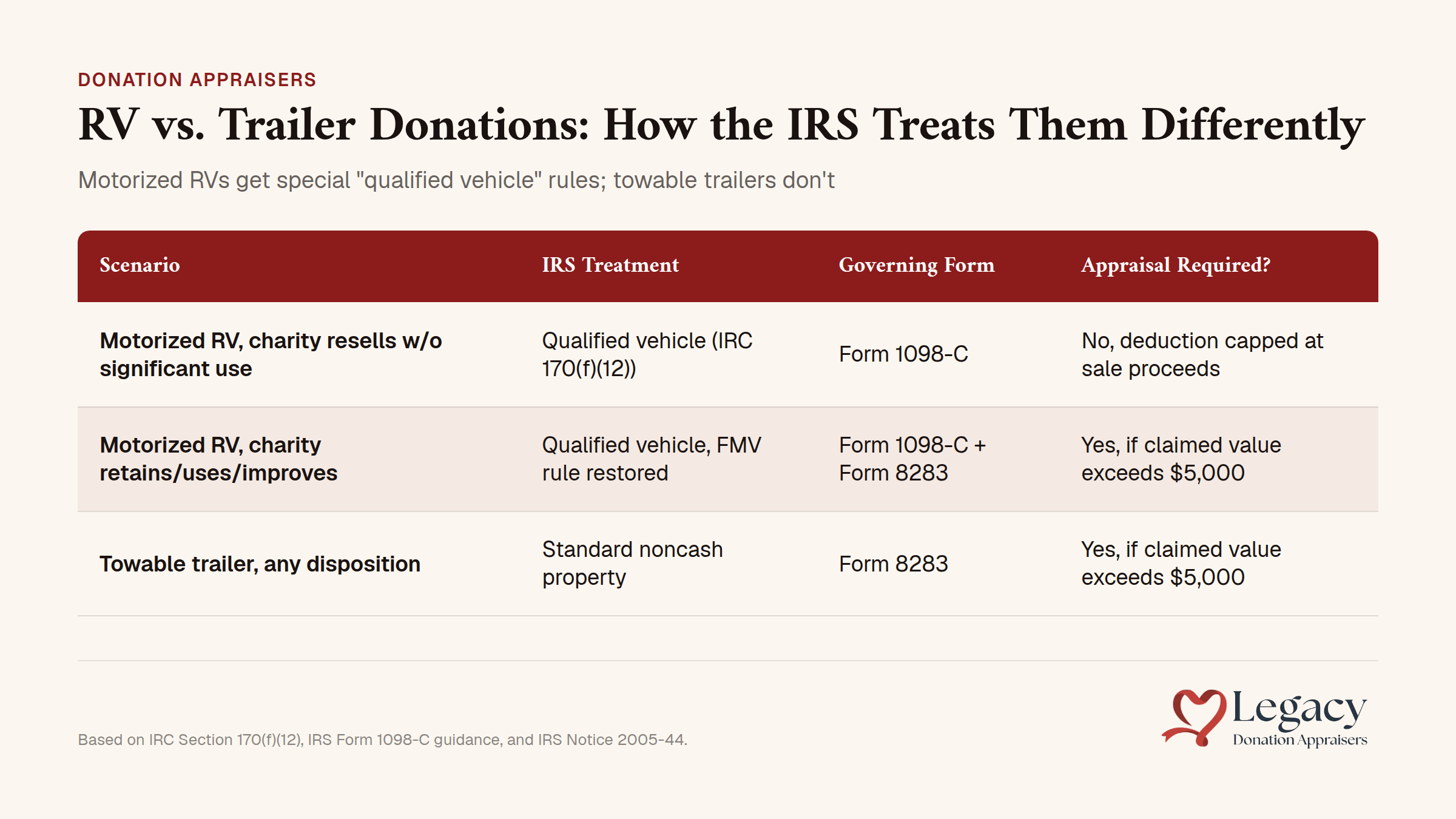
A motorized RV (a self-propelled motorhome) fits squarely within "motor vehicle" and is treated as a qualified vehicle. A towable trailer (a travel trailer, fifth-wheel, or toy hauler with no engine of its own) does not; it isn't a motor vehicle under the statute, so it never falls under this exception.
For qualified vehicles, the mechanics work like this: the donee charity issues a contemporaneous written acknowledgment, generally on IRS Form 1098-C, for any claimed value over $500. If the charity sells the vehicle without significant intervening use or material improvement, the donor's deduction is capped at the gross proceeds from that sale, not the vehicle's fair market value, and no qualified appraisal is required in that scenario, per IRS Notice 2005-44. If instead the charity keeps the RV and puts it to significant use, or materially improves it before selling, the donor can claim fair market value instead, and a qualified appraisal becomes relevant again once that value exceeds $5,000.
Towable trailers skip this whole detour. Because they're not motor vehicles, Form 1098-C never applies to them. A donated trailer follows the standard noncash property rule: if the claimed deduction exceeds $5,000, a qualified appraisal is required, full stop, regardless of whether the charity resells it or keeps it.
| Asset type | IRS treatment | Governing form | Appraisal required? |
|---|---|---|---|
| Motorized RV, charity resells with no significant use | Qualified vehicle under IRC 170(f)(12) | Form 1098-C | No, deduction capped at sale proceeds |
| Motorized RV, charity retains/uses/improves | Qualified vehicle, FMV rule restored | Form 1098-C plus Form 8283 | Yes, if claimed value exceeds $5,000 |
| Towable trailer (any disposition) | Standard noncash property | Form 8283 | Yes, if claimed value exceeds $5,000 |
What Determines Fair Market Value for an RV or Trailer?
Fair market value is the price a willing buyer would pay a willing seller, with neither under pressure and both reasonably informed, as of the donation date. General IRS guidance on determining value for noncash contributions applies this standard to every asset class, and RVs and trailers are valued the same way any specialized vehicle would be.
A handful of factors do most of the work in that determination:
- Age and model year: RVs depreciate quickly in their early years, so model year is usually the first adjustment an appraiser makes before looking at anything else.
- Mileage or engine hours: For motorized units, odometer mileage matters the same way it does for any vehicle. Generator hours and engine hours also factor in, since they signal remaining useful life on components that are expensive to replace.
- Overall condition: Roof integrity, slide-out mechanisms, chassis and suspension, tire age, appliance function, and interior wear all move the number. A unit with a compromised roof or water damage can be worth substantially less than the same model in excellent shape.
- Maintenance and repair history: Documented service records support a higher value; gaps or unknown history push it down.
- Upgrades and customization: Solar packages, upgraded suspension, custom interiors, and towing modifications can add value, though not always dollar-for-dollar.
- Comparable sales: The strongest support for any conclusion is actual arm's-length sales of similar units, adjusted for differences between the subject RV or trailer and the comparables, drawn from a normal market rather than a distressed or inflated one.
Example: A 2016 travel trailer in average condition with no major mechanical issues might appraise well below its original MSRP once age-based depreciation and comparable sales are factored in, while a well-maintained motorhome with documented service records and low engine hours can hold value closer to guide-book figures. The appraisal exists to show the IRS which of those scenarios actually applies to your unit.
How Our RV and Trailer Appraisal Process Works
Our appraisers start by collecting the details that drive the valuation: year, make, model, and VIN; mileage or engine hours where applicable; condition notes and photographs; and title or ownership documentation. From there, we build a USPAP-compliant valuation using comparable sales and current market data specific to the unit's type, configuration, and region.
The finished engagement includes a signed appraisal report and a completed Form 8283, Section B, ready to hand to your tax preparer. Our appraisers hold credentials with organizations such as CAGA and ASA, and every report is prepared in accordance with USPAP, the standard set by The Appraisal Foundation.
- Intake and Documentation - You provide identifying details, condition information, and photos for the RV or trailer.
- Market Research and Valuation - We pull comparable sales and adjust for age, mileage or hours, and condition to reach a supportable fair market value.
- Report Preparation - We draft a USPAP-compliant appraisal report along with the Form 8283, Section B summary.
- Delivery - You receive the signed report and completed form, ready for your tax filing.
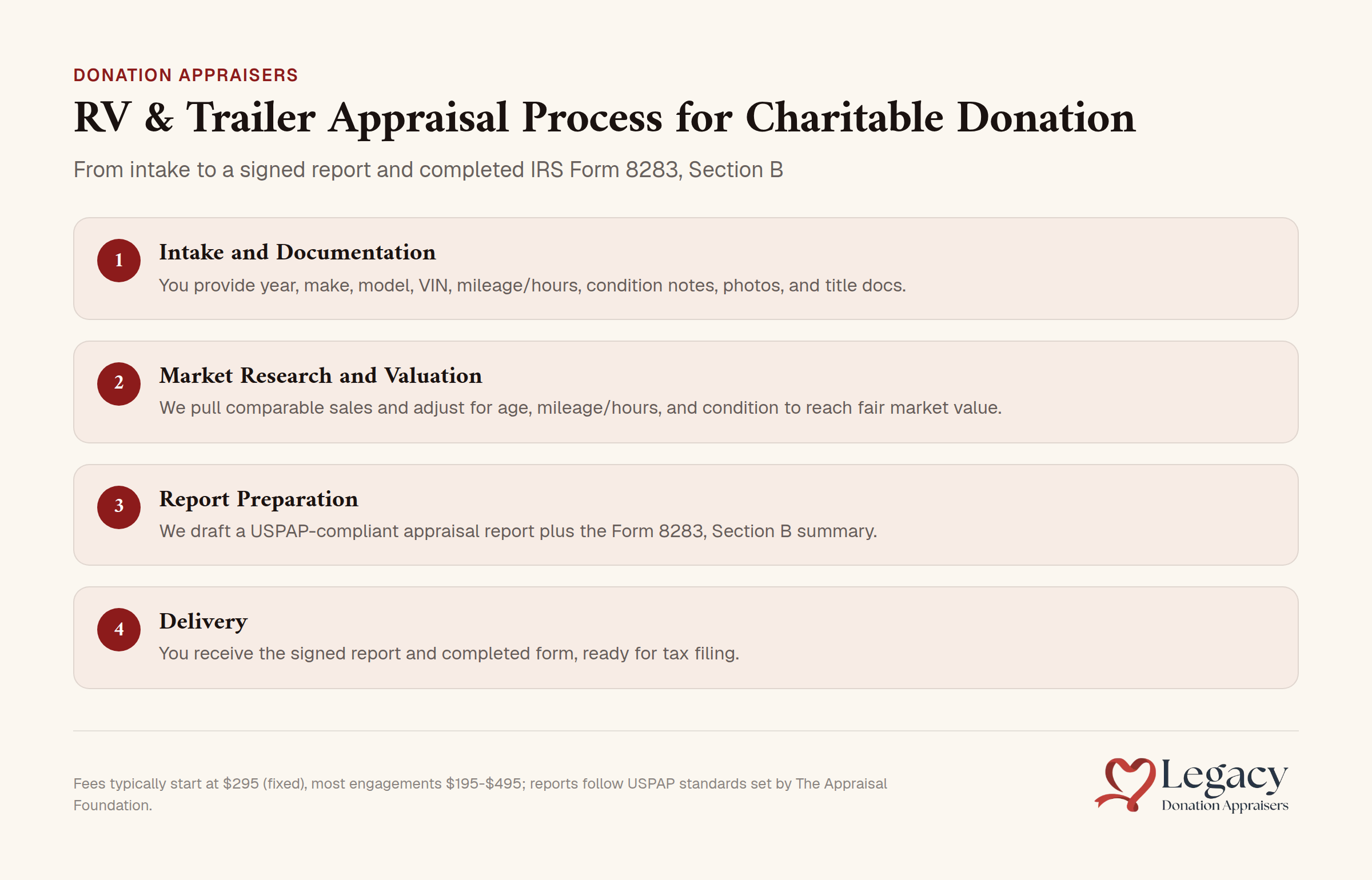
For a recreational vehicle or trailer, an IRS-qualified appraisal is typically quoted from $295 as a fixed fee, with most engagements landing between $195 and $495 depending on the unit's complexity and documentation. More involved assignments, such as custom builds or units with disputed title history, run higher. The fee is set after we scope the assignment and is never billed hourly.
Getting the Paperwork Right the First Time
The distinction between a motorized RV and a towable trailer isn't a technicality. It determines whether your deduction is capped at whatever the charity sells the unit for or whether you can claim full fair market value, and it determines whether a qualified appraisal is even on the table. Getting this wrong at filing time can mean a denied deduction long after the donation is done and the unit is gone.
If you're planning an RV or trailer donation and expect the claimed value to exceed $5,000, get the appraisal lined up before you finalize the transfer. Our team can scope the engagement, walk through which rule applies to your specific unit, and deliver a report built for Form 8283 from the start.
This article is provided for general informational purposes only and does not constitute legal, tax, or financial advice. Readers should consult a qualified attorney or CPA regarding their specific circumstances.