
Blog
How to Get a Qualified Appraisal for a SIRUM Prescription Drug Donation
Donating unexpired prescription medication to SIRUM can qualify as a charitable contribution, but claims over $5,000 generally require a qualified appraisal and IRS Form 8283 Section B. This guide explains how fair market value is determined for pharmaceutical inventory and how the rules differ for individual and corporate donors.
SIRUM is a nonprofit that redistributes surplus, unexpired medication from pharmacies, manufacturers, and individuals to clinics and patients who need it. Donors who give in meaningful quantities often want to claim a charitable deduction, and pharmaceuticals come with appraisal rules that are easy to get wrong. If you're weighing a donation of household medication alongside other personal property, our personal property appraisal service covers the broader category this type of gift often falls under.
When Does a SIRUM Donation Require a Qualified Appraisal?
For non-cash donations to a qualified 501(c)(3) like SIRUM, the IRS generally requires a qualified appraisal and Section B of Form 8283 once the claimed deduction exceeds $5,000. Below that, a completed Section A and reasonable recordkeeping are typically enough, though you still need to support the value claimed. Our threshold guide covers how this applies once a donor gives medication in more than one batch during the same tax year.
A receipt or acknowledgment letter from SIRUM confirms a donation happened. It does not establish what that donation was worth; those are two different documents.
Individual Donors vs. Corporate Inventory Donations
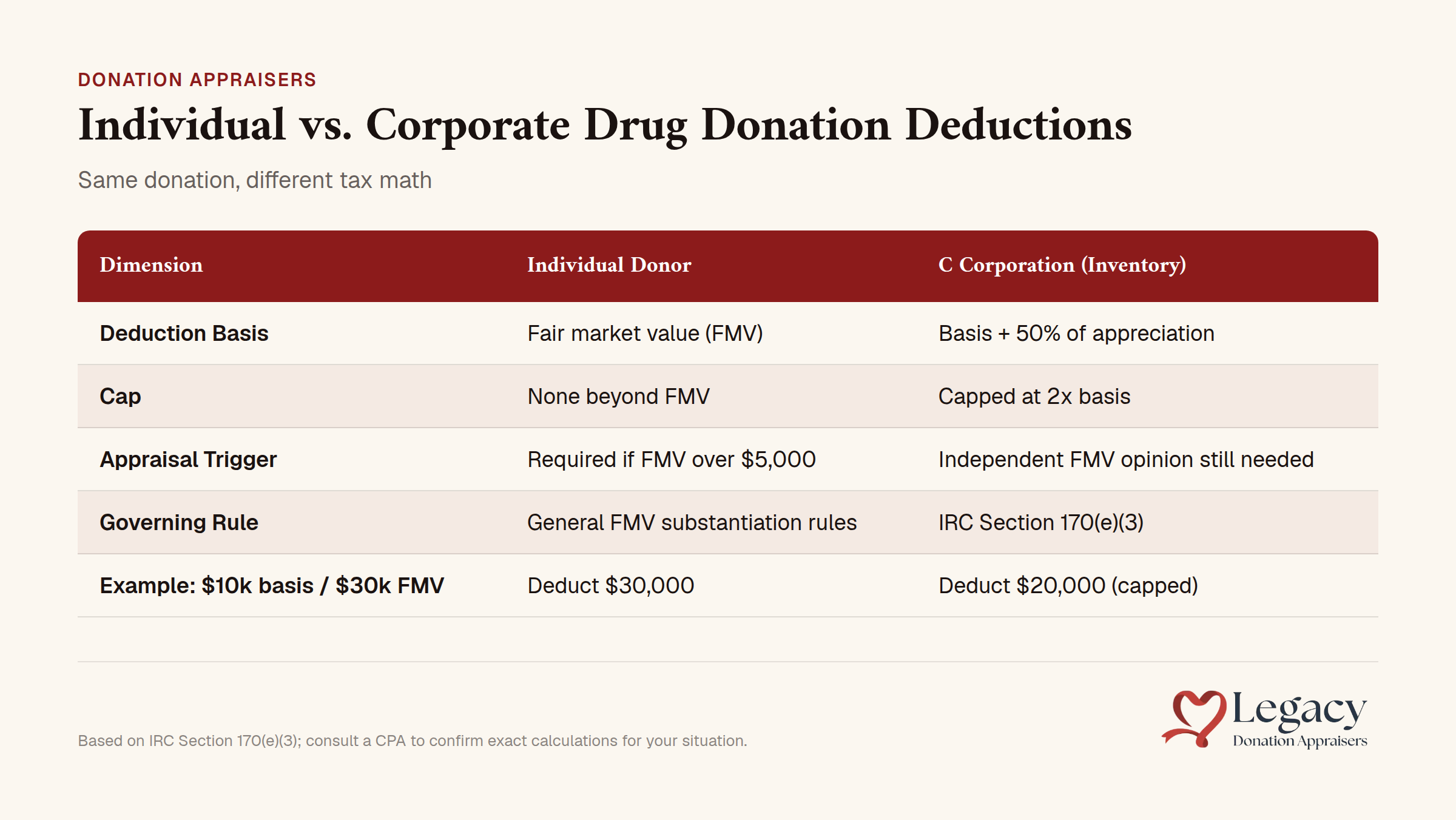
The rules differ depending on who is giving the medication, and this is a tax question worth confirming with a CPA before the donation is finalized. An individual donor generally deducts based on the fair market value of the medication at the time of the gift, subject to the appraisal rules above. A business or manufacturer donating pharmaceuticals out of inventory falls under IRC Section 170(e)(3) instead, which can allow an enhanced deduction tied to cost basis plus a portion of appreciation, a different and more limited calculation than the FMV approach individuals use.
We prepare the independent fair market value opinion either way; how that value flows into the final deduction is a calculation the donor's CPA handles. Businesses donating in bulk should also look at our inventory appraisal service, built for this kind of itemized, bulk valuation.
How Is Fair Market Value Determined for Unexpired Medication?
Fair market value is the price a willing buyer and willing seller would agree to, with neither under compulsion. That standard works cleanly for a used car or a painting because there's an active resale market. Pharmaceuticals don't have one, so there's no comparable-sales approach to lean on.
Instead, value has to be built from documented wholesale or market pricing tied to the specific product: the National Drug Code (NDC) number, dosage form and strength, quantity donated, and remaining shelf life. Medication that's expired, or close enough to expiration that it can't realistically be redistributed, carries little to no fair market value regardless of what it originally cost.
Documentation SIRUM and the IRS Both Expect
The IRS wants records supporting the claimed value: NDC numbers, lot numbers, expiration dates, quantities, and condition, tied to a qualified appraisal once the deduction exceeds $5,000.
SIRUM has its own acceptance criteria, separate from the tax rules, typically requiring donated product to be unexpired, unopened, and in sealed original packaging. Confirm SIRUM's current criteria directly with the organization before finalizing a donation. Product that gets rejected at intake never becomes a completed gift, no matter how it might otherwise be valued.
What a USPAP-Compliant SIRUM Donation Appraisal Includes
Our appraisers prepare pharmaceutical inventory donation appraisals in accordance with the Uniform Standards of Professional Appraisal Practice (USPAP), the standard published by The Appraisal Foundation. For a SIRUM donation, that typically means an independent fair market value determination, a documented inventory tying each line item to its NDC number, lot number, expiration date, and quantity, and a report structured to support Section B of Form 8283 when the deduction exceeds $5,000. Every engagement is quoted as a fixed fee once we understand the scope of the donation.
What we don't do, and what no appraiser should promise, is guarantee the IRS will accept a given deduction amount. That's the IRS's call. A properly prepared appraisal gives a donor a documented, independent, standards-compliant basis for the value claimed.
Getting the Deduction Right Without Overpromising
A SIRUM donation of unexpired medication can be a meaningful gift and, for many donors, a legitimate deduction. Treat the appraisal and the tax question as separate tracks: an independent valuation grounded in documented pricing for the specific drug and lot, and a conversation with a CPA about which deduction rules apply. Confirm SIRUM's acceptance criteria first, document the inventory thoroughly, and bring in a qualified appraiser once the value is likely to cross the reporting threshold.
This article is provided for general informational purposes only and does not constitute legal, tax, or financial advice. Readers should consult a qualified attorney or CPA regarding their specific circumstances.