
Blog
Timeshare Appraisal for Donation: IRS Qualified Appraisal Rules and Fair Market Value
A timeshare appraisal for donation must meet the same IRS qualified appraisal and fair market value standards as any other non-cash gift, and the resale market, not the original purchase price, sets that value. This guide walks through the $5,000 appraisal threshold, the FMV rules, and why so many timeshares end up worth far less than donors expect.
Donating a timeshare sounds like a clean way to walk away from an asset you no longer want while claiming a tax deduction. In practice, the IRS treats a timeshare interest as non-cash property subject to the same substantiation rules as donated real estate, artwork, or business equipment, and the appraisal process often reveals a fair market value far below what the donor expects. This guide covers when a qualified appraisal is required, how fair market value is actually determined for a timeshare, and why so many charities decline these donations outright.
Why a Qualified Appraisal Is Required for Timeshare Donations Over $5,000
A qualified appraisal is required any time a donor claims a deduction of more than $5,000 for a timeshare, because the IRS classifies timeshares as non-cash property under the same rules that govern real estate, art, and equipment gifts. Once the claimed deduction crosses that threshold, the donor must complete Section B of IRS Form 8283 and have a qualified appraiser sign it, not just estimate a number based on what they originally paid. Our guide to IRS Form 8283 walks through the full form in more detail, including the $5,000 threshold that triggers Section B.
The appraiser performing the work also has to meet a specific qualification standard. IRS Publication 561 describes a qualified appraiser as someone with verifiable education and experience valuing the type of property in question, who is not the donor, the recipient charity, or related to either party, and who is not being paid a fee based on a percentage of the appraised value. A general real estate appraiser who has never valued a timeshare interest may not have the specific market knowledge the IRS expects, since timeshare resale markets behave very differently from traditional real estate.
Timing matters just as much as qualifications. Under Treasury Regulation 1.170A-17, the appraisal must be dated no earlier than 60 days before the date of the donation, and it must be completed before the due date, including extensions, of the tax return on which the deduction is first claimed. A timeshare appraisal that is too old by the time you file, or one performed after the return deadline, does not satisfy the qualified appraisal requirement no matter how accurate the number turns out to be.
How Fair Market Value Is Determined for a Timeshare Interest
Fair market value for a donated timeshare is the price a willing buyer would pay a willing seller in the actual resale market, not the price the developer originally charged. This willing buyer, willing seller standard applies to every category of donated property, and Publication 561 makes clear that neither party can be under any compulsion to transact and both must have reasonable knowledge of the relevant facts. For a timeshare, that means the appraiser has to look at what similar intervals actually sell for on the secondary market, not what a sales presentation quoted decades ago.
This distinction matters enormously in practice. Developer retail pricing bakes in sales commissions, marketing costs, and amenities that do not transfer into resale value. Secondary market listings for comparable timeshares routinely sell, when they sell at all, for a small fraction of the original purchase price, according to consumer resources tracking timeshare resale activity. An appraiser building a defensible fair market value has to anchor the conclusion in that resale data, not in the donor's purchase contract.
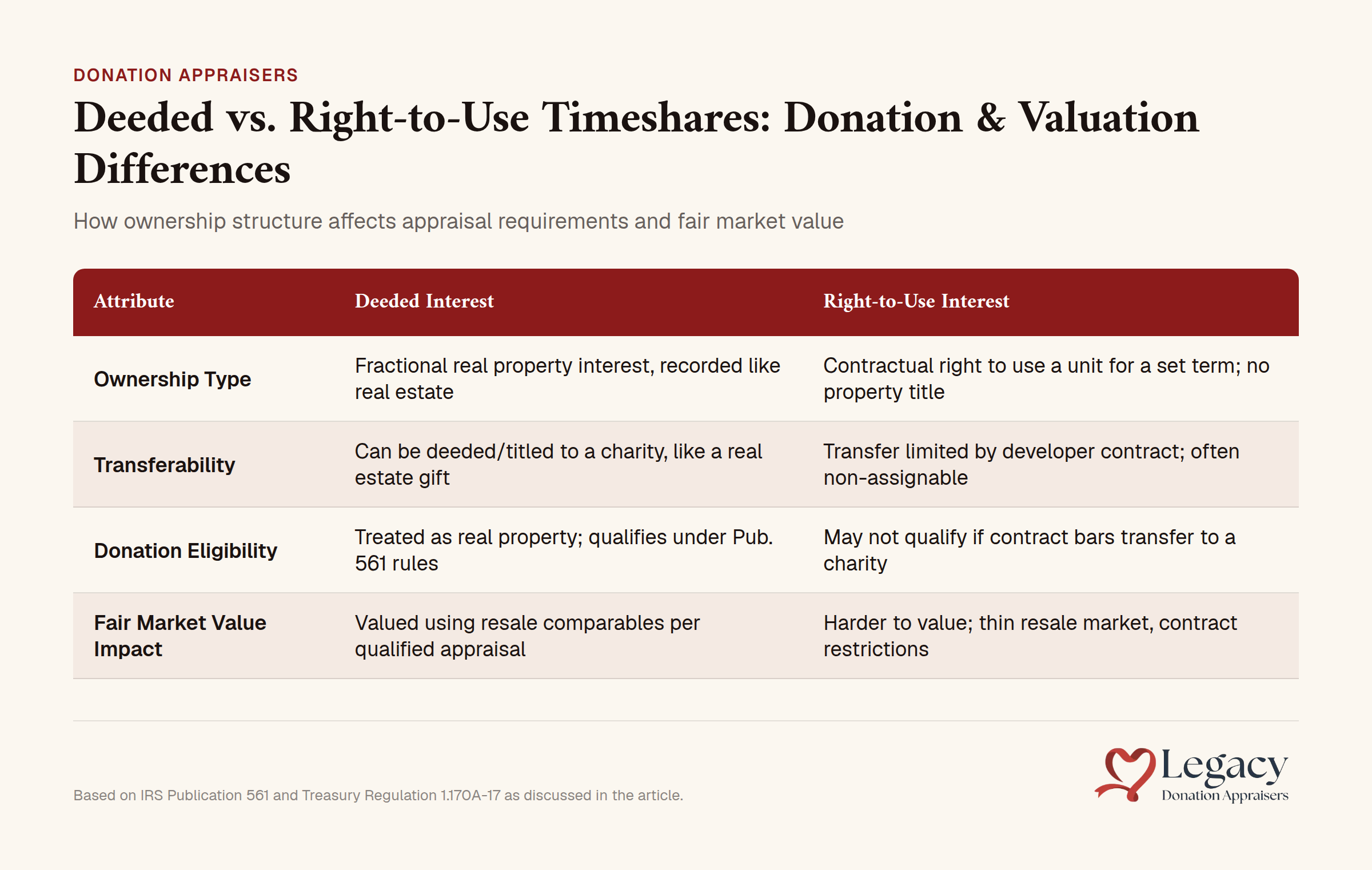
The structure of the ownership interest also drives both eligibility and value. Timeshares generally fall into two categories:
- Deeded (real property) interests: These convey an actual fractional ownership interest in the underlying real estate, recorded like any other real property deed. A deeded interest can typically be transferred to a charity because ownership itself changes hands.
- Right-to-use (contractual) interests: These are a license or contractual right to use a unit for a set period, without an ownership stake in the real estate itself. Whether a right-to-use interest can be donated at all depends on whether the underlying contract permits assignment or transfer to a third party, according to legal analyses of timeshare tax issues.
Ongoing costs weigh down resale value regardless of structure. Annual maintenance fees and periodic special assessments follow the interest to whoever holds it, and a buyer (or a charity considering accepting the gift) will discount what they are willing to pay to account for those recurring obligations, as several consumer and legal resources on timeshare donations point out. A timeshare with a $1,200 annual maintenance fee and weak resale demand can easily appraise well below what most donors assume.
Why Timeshares Are Notoriously Hard to Donate
Timeshares are hard to donate because most charities decline them outright, and even when a charity is willing to accept one, the fair market value an appraisal supports is often minimal. Unlike a piece of furniture or a vehicle, a timeshare comes with a perpetual liability attached: whoever holds title or the right-to-use contract owes ongoing maintenance fees and is exposed to special assessments that can increase without notice. A charity that accepts the gift inherits that liability, and many nonprofits have adopted blanket policies against accepting timeshares for exactly that reason.
Watch out: A donor who assumes their timeshare is worth what they paid for it, and then discovers the appraised fair market value is a few hundred dollars or even effectively zero, is not unusual. This outcome does not mean the appraisal was done incorrectly; it means the resale market for that specific interval is weak, and the IRS requires the appraisal to reflect market reality rather than sentimental or purchase-price value.
Several additional factors compound the problem. Resale demand for most timeshare intervals is thin, and legal commentary on the realities of donating a timeshare describes situations where owners have had to pay third parties simply to take a timeshare off their hands. If the interest is a right-to-use contract rather than a deeded ownership stake, the donation may not be legally possible at all if the underlying agreement does not permit assignment to a charity. And because the IRS only allows a deduction for a transferred ownership interest, not for donating the mere use of a week (such as giving a charity one week of occupancy for an auction), donors sometimes discover their intended gift does not qualify for a property deduction in the first place.
What Documentation You Need to Gather
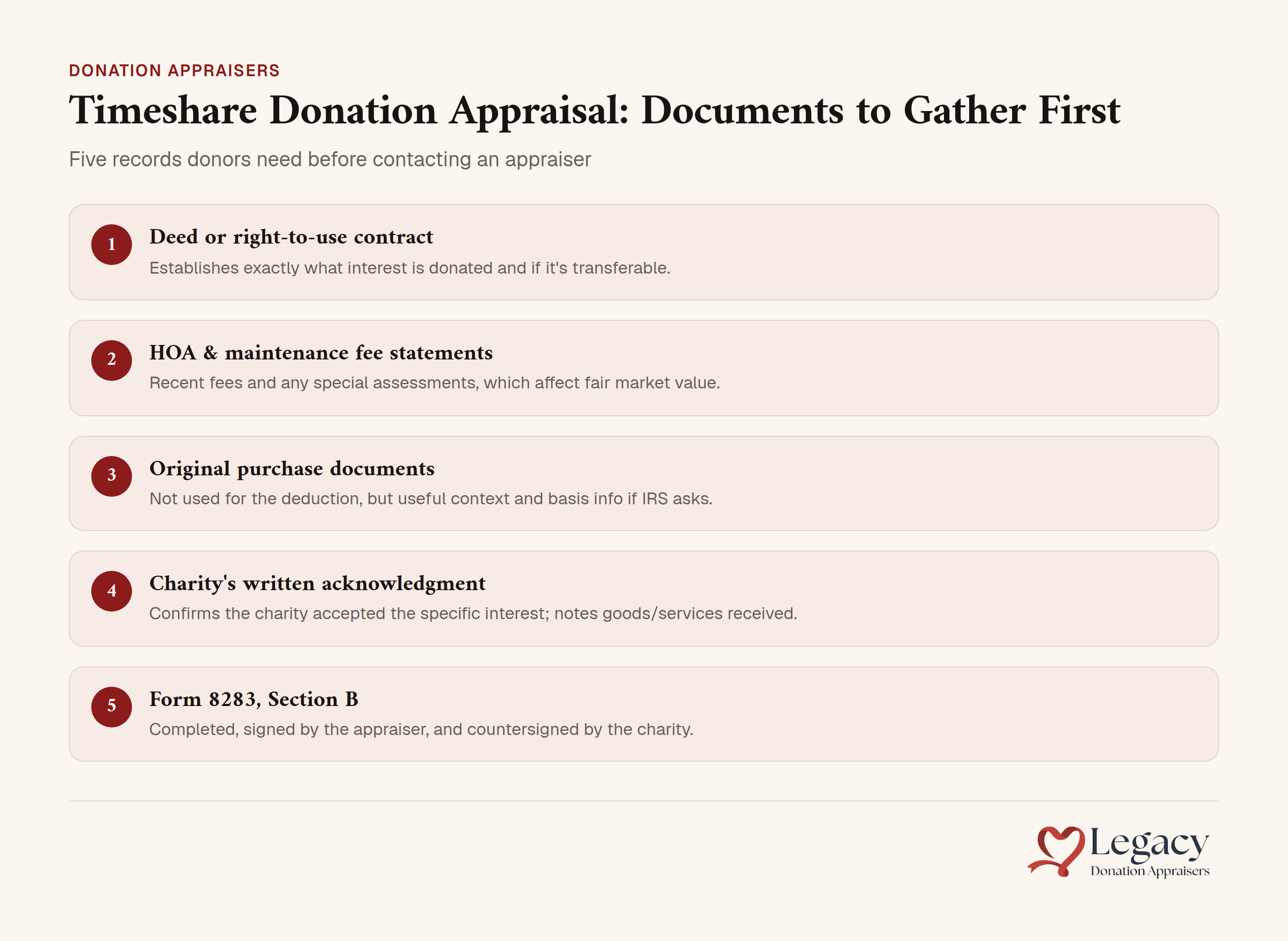
A timeshare donation appraisal moves faster and holds up better under IRS scrutiny when the donor arrives with complete records. Before contacting an appraiser, gather the following:
- The deed or right-to-use contract: This establishes exactly what interest is being donated and whether it is legally transferable.
- HOA and resort maintenance fee statements: Recent statements showing annual fees and any pending or recent special assessments, since these directly affect fair market value.
- Original purchase documents: Not used to set the deduction, but helpful context for the appraiser and useful if the IRS asks about basis.
- Written acknowledgment from the receiving charity: Confirming the charity has accepted the specific interest and describing any goods or services provided in return, as required for substantiating non-cash contributions.
- Completed Form 8283, Section B: Signed by the appraiser and countersigned by the charity once the appraisal is finished.
How Legacy Donation Appraisers Supports Your Timeshare Donation
Our role is to determine a defensible, USPAP-compliant fair market value for the timeshare interest you intend to donate, not to guarantee any particular outcome with the IRS or with a receiving charity. We research the actual resale market for the resort, brand, and interval type, account for outstanding maintenance obligations and any special assessments, and document the valuation method in a report that meets the requirements of a qualified appraisal under Treasury Regulation 1.170A-17.
That honesty cuts both ways. If the resale market supports only a modest value, or close to zero, the report will say so, because an appraisal that inflates value to match a donor's expectations is not a qualified appraisal at all. Donors considering a gift of any personal property with a similarly thin resale market should expect the same standard: the number reflects the market, not the wish.
Key takeaway: A timeshare appraisal for donation exists to protect the donor's deduction with a defensible number, not to produce the highest number possible. Before you commit to donating, confirm the charity will actually accept the interest and understand that the appraised value may be modest.
Frequently Asked Questions
Q: Are ongoing timeshare maintenance fees deductible as a charitable contribution? No. Maintenance fees are a cost of ownership, not a charitable gift, and they are not deductible on their own. If you pay a maintenance fee or special assessment before transferring the timeshare to a charity, that payment is a personal expense, not part of the donation.
Q: What happens if the appraisal shows the timeshare has negative resale value? If the appraiser determines that market conditions and outstanding obligations leave the interest with negligible or effectively no fair market value, that is the value that gets reported. A near-zero valuation does not disqualify the donation, but it does mean the deduction will be small, and in some cases a charity may decline to accept an interest it views as a net liability.
Q: Can a right-to-use timeshare be donated the same way as a deeded timeshare? Not always. A right-to-use interest is a contractual license rather than an ownership stake, and whether it can be transferred to a charity depends entirely on the terms of the underlying agreement. Review the contract, or have your appraiser flag transferability issues, before assuming the interest can be donated at all.
Q: Do I need a new appraisal if my last one is a few months old? Generally yes. The appraisal must be dated no earlier than 60 days before the donation date and completed before your tax return's due date, so an appraisal performed further back than that window will not satisfy the qualified appraisal requirement.
This article is provided for general informational purposes only and does not constitute legal, tax, or financial advice. Readers should consult a qualified attorney or CPA regarding their specific circumstances.