
Blog
What Makes an Appraisal Count as IRS-Qualified for a Charitable Gift?
IRS-qualified appraisal services follow a specific set of rules under IRC Section 170(f)(11): the right appraiser, the right timing, and a report that meets USPAP and Form 8283 standards. Here's exactly what those rules require and how a compliant appraisal is built.
Donating property to charity feels simple until the IRS asks for proof of value. Once a noncash donation crosses certain dollar thresholds, a casual estimate will not hold up, and the law requires a specific kind of documentation: a qualified appraisal prepared by a qualified appraiser. This guide walks through exactly what those two terms mean under IRC Section 170(f)(11), how USPAP fits into the picture, and what Form 8283 requires from the donor, the appraiser, and the charity.
Our personal property appraisal service for charitable donation is built around these exact requirements, so this is also a look at what happens behind the scenes on every report we prepare.
The $5,000 Threshold That Triggers a Qualified Appraisal
A qualified appraisal is generally required whenever a donor claims a deduction of more than $5,000 for an item or group of similar items of donated property, according to IRS Publication 561. Below that line, a donor still needs to support the claimed value, but a formal qualified appraisal is not mandatory.
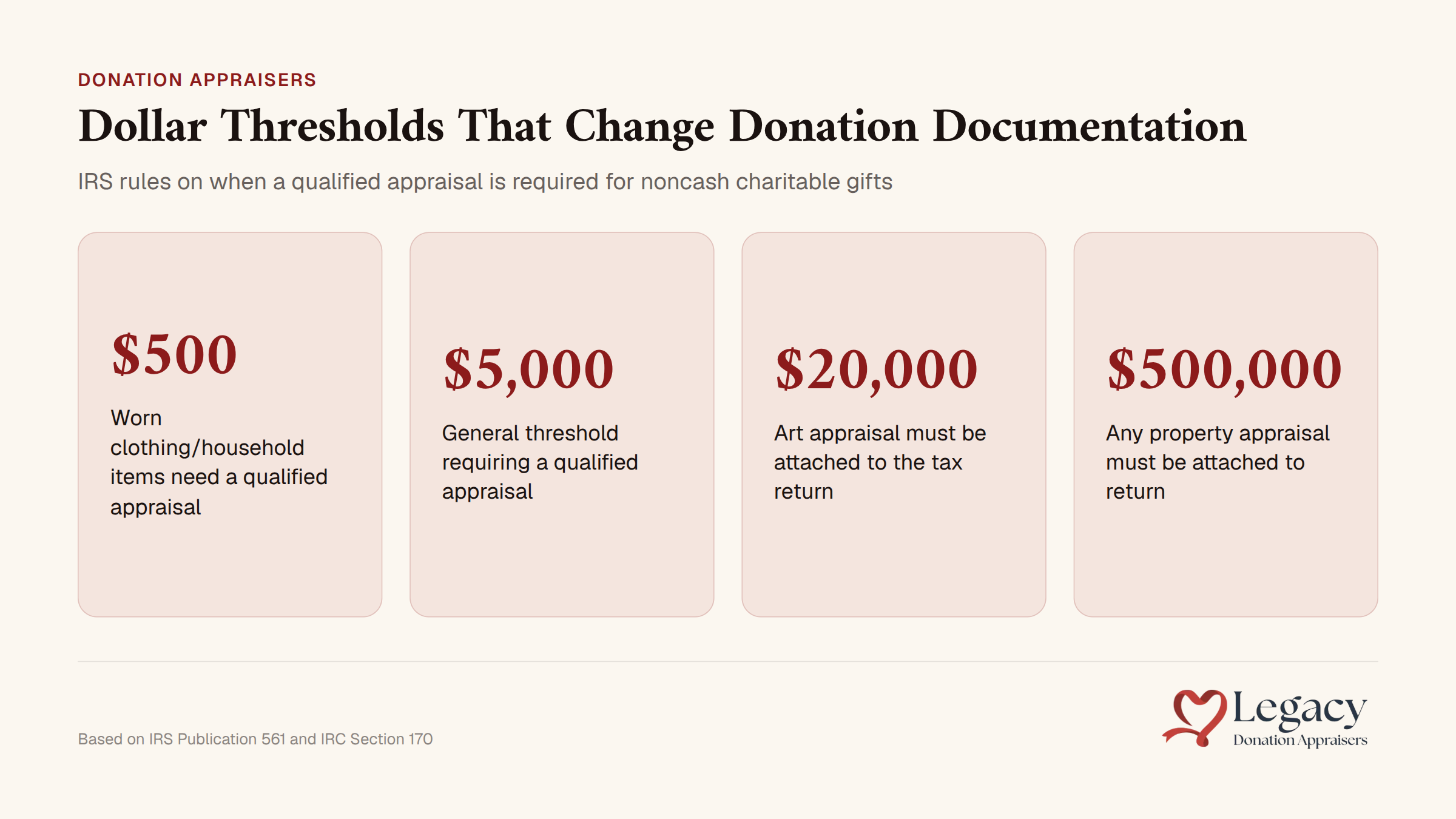
Three other thresholds matter just as much:
- $500 for used clothing and household items. If a single item of clothing or a household item is not in good used condition and the claimed value is more than $500, a qualified appraisal is required even though the value falls well under the general $5,000 line, per IRS Publication 561.
- $5,000 for most other noncash property. This is the general rule covering everything from furniture and jewelry to equipment and collectibles, and it is the threshold most donors need to plan around, as detailed in our guide on donations over $5,000.
- $20,000 for art. Publication 561 specifies that when a donor claims $20,000 or more for donated art, a complete copy of the qualified appraisal itself must be attached to the return, not just referenced on Form 8283.
- $500,000 for any property. Once a claimed deduction for any noncash property exceeds $500,000, the statute requires the qualified appraisal to be attached to the tax return, according to IRC Section 170.
A handful of donation types are exempt from the qualified appraisal requirement altogether, including certain publicly traded securities, some intellectual property, inventory, and vehicles where the deduction is limited to the gross sale proceeds under a contemporaneous written acknowledgment. Outside those exceptions, crossing $5,000 (or $500 for worn clothing and household goods) is the line that changes everything about how a donation needs to be documented.
What Is a Qualified Appraisal Under IRC Section 170(f)(11)?
A qualified appraisal is a written appraisal document that meets specific statutory and regulatory standards, not simply any signed opinion of value. Under IRC Section 170(f)(11), it must be prepared by a qualified appraiser, follow generally accepted appraisal standards, and satisfy detailed content and timing rules.
The timing rule is one of the most commonly missed requirements. The appraisal must be dated no earlier than 60 days before the date the property is contributed, and the donor must receive it before the due date, including extensions, of the return on which the deduction is first claimed. If the deduction is first claimed on an amended return, the appraisal must be in hand before that amended return is filed. Miss either end of that window and the appraisal is not qualified, no matter how accurate the value.
A qualified appraisal must also include specific content, generally covering:
- A detailed description of the property sufficient to identify what was donated, including its physical condition.
- The date of the contribution and the effective date of the valuation.
- The specific valuation method used and the basis for the conclusion, such as comparable sales or market data.
- A statement of the appraiser's qualifications and background in valuing that type of property.
- The appraiser's signature, the date signed, and confirmation that no part of the fee is based on a percentage of the appraised value.
These content and timing standards come directly from the Treasury regulations implementing Section 170(f)(11), and they leave little room for shortcuts. An appraisal missing the appraiser's signature, dated outside the 60-day window, or silent on methodology simply does not meet the definition, according to the governing Treasury regulation.
Who Counts as a Qualified Appraiser?
Not every credentialed professional automatically qualifies to sign off on a donation appraisal. A qualified appraiser is an individual who has earned an appraisal designation from a recognized professional organization, or who has otherwise met minimum education and experience requirements, and who regularly performs appraisals for compensation.
Just as important is who is excluded. A qualified appraiser cannot be:
- The donor, or the party who claims the deduction.
- The donee organization receiving the gift.
- A person employed by, married to, or related to the donor or donee.
- Anyone whose relationship to the transaction would cause a reasonable person to question their independence.
- An appraiser who performs the majority of their appraisals for the parties involved in the donation rather than for the general public.
There is a narrow exception: someone who sold, exchanged, or gave the property to the donor may still sign the appraisal if the donation occurs within two months of the donor acquiring the property and the appraised value does not exceed the acquisition price. Outside that specific scenario, independence is not optional.
Pro tip: Lack of a formal certificate or membership does not automatically disqualify an appraiser, and holding one does not automatically qualify them either. What matters is documented education, relevant experience, and a regular, independent appraisal practice.
USPAP Compliance: the Standard Regulators Point To
The regulations implementing Section 170(f)(11) require a qualified appraisal to follow "generally accepted appraisal standards," and the Uniform Standards of Professional Appraisal Practice (USPAP) is the benchmark most consistently cited to meet that test. USPAP is published and maintained by The Appraisal Foundation and sets the rules for scope of work, ethics, independence, and report content that a defensible appraisal is expected to follow.
USPAP's ethics requirements also line up with the IRS rule against contingent fees: an appraiser cannot be paid a percentage of the value they conclude. That overlap is not a coincidence. Both frameworks exist to keep the appraiser's opinion independent of the outcome the donor might prefer.
Our appraisers hold credentials with organizations including the ASA, ISA, and AAA, and every report we prepare is written to be consistent with USPAP, regardless of asset type. That is the standard a qualified appraisal is measured against, and it applies whether the donated property is a painting, a vehicle, a business interest, or a warehouse of inventory.
What Form 8283 Requires From Everyone Involved
Form 8283 is the mechanism that ties the appraisal to the tax return, and its requirements scale with the size of the deduction. According to the Form 8283 instructions, any noncash contribution over $500 requires the form to be filed, while contributions over $5,000 require completion of Section B, which is built around the qualified appraisal itself.
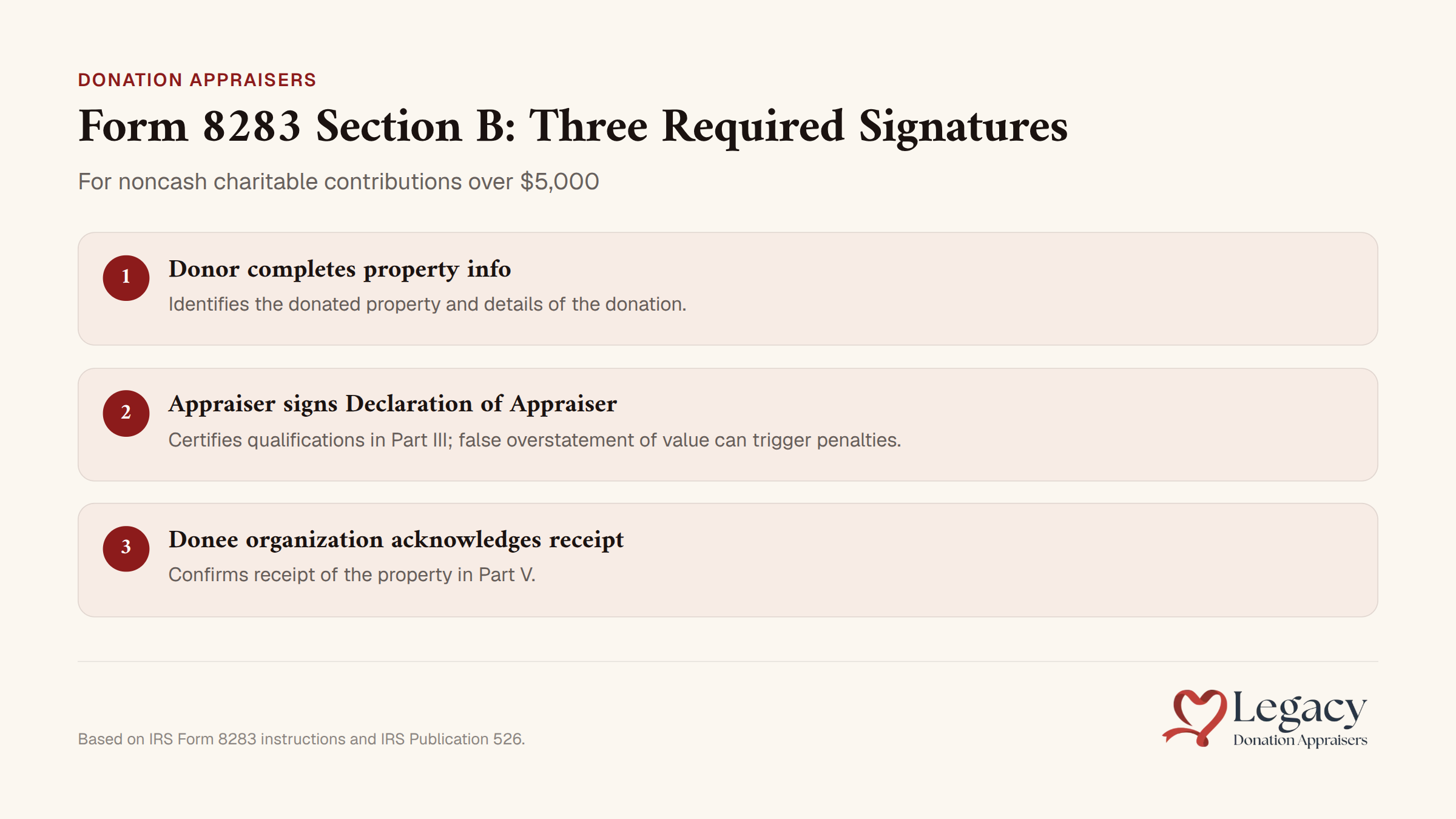
Section B requires signatures from three separate parties:
- The donor, who completes information identifying the property and the donation.
- The qualified appraiser, who completes the Declaration of Appraiser in Part III, certifying their qualifications and that they understand a false or fraudulent overstatement of value can result in penalties.
- The donee organization, which acknowledges receipt of the property in Part V.
Generally, the appraisal itself does not need to be attached to the return; the donor keeps a copy in case the IRS requests it later. There are exceptions worth remembering, and our guide on attaching an appraisal to Form 8283 covers them in more depth: art donations of $20,000 or more, and any deduction over $500,000, both require the full appraisal to be attached rather than simply referenced.
The IRS reviews these filings closely. Publication 526 notes that the agency may accept the claimed value as filed, request more information from the taxpayer, or refer the valuation to an IRS appraiser or the Art Appraisal Services unit for a second opinion. A properly completed, USPAP-consistent appraisal and a correctly signed Form 8283 are what give a donor's filing the best chance of holding up to that scrutiny.
How We Build Every Appraisal Around These Requirements
We structure every donation appraisal engagement to align with the standards above from the start rather than trying to patch gaps after the fact. That means assigning a credentialed appraiser with genuine experience in the relevant asset category, timing the valuation date to fall correctly within the 60-day window before contribution, and preparing the written report in accordance with USPAP so it includes the description, methodology, and appraiser qualifications the regulations call for.
Our team also completes the Declaration of Appraiser in Section B of Form 8283 directly, so the signature, identifying information, and certification are handled correctly rather than left to guesswork. Engagements are quoted as a fixed fee after we understand the scope of the donation, including the type of property, the number of items, and whether the donation calls for standard or IRS-qualified reporting. Fees are never based on a percentage of the value we conclude, consistent with both USPAP and the IRS rule against contingent appraisal fees.
None of this guarantees how the IRS will treat a specific filing; that determination belongs to the agency, not to us. What we can control is preparing a report that is built to the standard the regulations describe: independent, USPAP-consistent, correctly timed, and properly documented on Form 8283.
This article is provided for general informational purposes only and does not constitute legal, tax, or financial advice. Readers should consult a qualified attorney or CPA regarding their specific circumstances.